
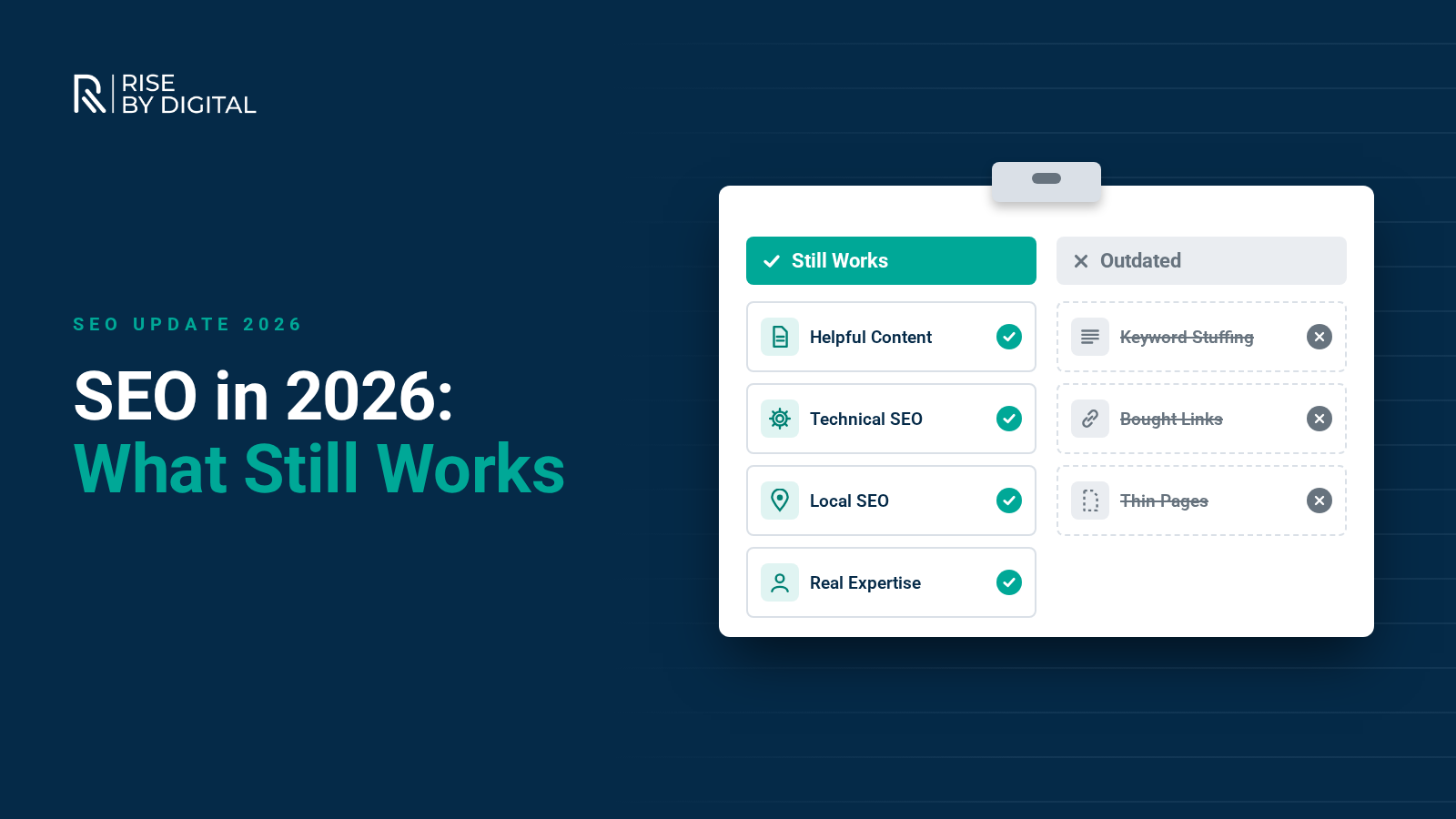
Updated for 2026: the SEO tactics that still work, the ones that are now outdated or risky under Google's spam policies, and what AI Overviews and AI Mode change.
Every year brings a new wave of claims that "SEO is dead". It is not, but it has changed. Since we first published this article in early 2025, Google's AI Overviews and AI Mode have become a normal part of search, Google has tightened its spam policies, and the old shortcuts work even less than they used to.
We have updated this guide for 2026. It covers what still works, what is now outdated or risky, and what is genuinely new, with links to Google's own guidance so you can check the detail yourself.
What still works
1. Helpful content written for people
This remains the foundation. Google's guidance on creating helpful, reliable, people-first content asks whether your content shows real expertise, answers the question fully and leaves the reader satisfied. Pages written mainly to attract search traffic, rather than to help someone, tend to struggle.
In practice, that means writing from experience: real examples, real prices where you can share them, clear explanations and honest advice about when something is not right for the reader.
2. Strong technical foundations
Google has to be able to find, crawl and index your pages before anything else matters. The basics still apply:
- A clear site structure with sensible internal links
- An up-to-date XML sitemap submitted in Search Console
- No important pages blocked by robots.txt or noindex tags
- One preferred version of each page, using redirects or canonical tags for duplicates
- HTTPS across the whole site
Our SEO audit checklist walks through these in order.
3. A good mobile experience
Google uses the mobile version of your site for indexing and ranking, as explained in its mobile-first indexing guidance. If content, links or structured data are missing from your mobile pages, Google may not see them at all.
4. Page experience and Core Web Vitals
Fast, stable pages help visitors and support your search performance. Google says good Core Web Vitals align with what its core ranking systems seek to reward, but relevance comes first. Our website speed guide explains the metrics, including INP, which replaced First Input Delay in 2024.
5. Local SEO
For businesses serving a town or region, a complete and active Google Business Profile, consistent contact details and genuine reviews remain essential. Our guide to local SEO covers the full process.
6. Earning links and mentions
Links from relevant, reputable sites still help Google understand which pages are trusted. What has changed is how they are earned: through useful content, genuine partnerships, local press and industry involvement, not by buying or swapping them. Our beginner's guide to backlinking explains what is safe.
7. Clear titles, headings and structured data
A descriptive title, a helpful meta description and logical headings make it easier for both people and search engines to understand a page. Structured data still helps Google interpret content such as products, reviews, events and local business details, provided it matches what is visible on the page.
What's outdated (or now risky)
Keyword stuffing
Repeating a phrase over and over to rank has been ineffective for years, and keyword stuffing is named in Google's spam policies. Write naturally and cover the topic properly instead.
Mass-produced pages, including AI-generated ones
Google's spam policies now include scaled content abuse: producing many pages mainly to manipulate rankings, however they are created. Google's guidance on generative AI content says AI can be useful for research and structure, but generating many pages without adding value may break that policy. Using AI is not the problem; publishing thin, unchecked content at scale is. We explore this further in why AI content still needs human creativity.
Manipulative link building
Buying links that pass ranking credit, excessive link exchanges and links from low-quality directories are all listed as link spam by Google. They can lead to links being ignored or to manual action against your site.
Shortcuts that borrow someone else's reputation
Two newer spam policies target tactics that became popular around 2023 and 2024. Site reputation abuse covers publishing third-party content on a trusted site mainly to exploit its rankings. Expired domain abuse covers buying old domains and filling them with low-value content to benefit from their history. Both are now explicitly prohibited.
Chasing FAQ rich results
For a while, adding FAQ markup to every page was standard advice. Since August 2023, Google shows FAQ rich results only for well-known, authoritative government and health websites. Good FAQs are still useful to readers, but do not expect extra space in the results for them.
Writing to a word count
There is no magic length. Google's own helpful content guidance asks if you are writing to a particular word count because you think Google prefers one, and answers plainly: "No, we don't." Write as much as the topic needs, and no more.
Treating voice search as a separate strategy
Our 2025 version listed voice search optimisation as a priority. In practice, Google does not publish a separate playbook for voice. Clear, natural answers to real questions serve voice, text and AI search alike, so we no longer treat it as a standalone tactic.
Sitemap priority settings
Many sites still fine-tune priority and change frequency values in their sitemaps. Google states that it ignores the priority and changefreq values and uses lastmod only where it is consistently accurate.
What's new for 2026: AI in search
AI Overviews and AI Mode summarise answers and link to sources. Google says there are no additional requirements or special optimisations needed to appear in them: the same SEO best practice applies. That is reassuring, but it also raises the bar. If an AI summary answers simple questions directly, your content needs to offer something more: depth, experience, local knowledge, original data or a clear next step.
Our guide to SEO, AEO and GEO explains the new terms you will hear and how much they really change.
Your 2026 SEO checklist
- Key pages indexed and free of crawl errors in Search Console
- Content reviewed for accuracy and usefulness, not word count
- Thin or duplicated pages improved, merged or removed
- Mobile pages contain the same content and links as desktop
- Core Web Vitals checked for your main templates
- Google Business Profile complete and active, if you serve a local area
- No paid or swapped links that pass ranking credit
- AI-assisted content checked and improved by a human before publishing
- Structured data matches visible content
- Results reviewed monthly, with patience: Google says changes can take a few hours to several months to show
What this means for a small business
You do not need to chase every change. For most small and medium-sized businesses, the priorities for 2026 are simple. Make sure Google can index your important pages. Keep your service and location pages genuinely useful, with clear prices or price guidance where you can share it. Look after your Google Business Profile and reviews. Publish a smaller number of well-researched articles rather than a large volume of generic ones. And avoid anyone who promises fast results through link packages or mass-produced content, because those are the tactics Google's policies are designed to catch.
Where to start
If you have not reviewed your SEO in the past year, start with an audit rather than a list of tactics. It will show you which of these points actually apply to your site. Our team offers a free SEO audit, and our managed SEO packages cover technical work, content and link earning in line with Google's guidelines.