
How UK businesses should measure email ROI, what industry benchmarks actually mean, and when email beats paid social for retention.
Is email marketing still worth it? For many UK businesses the question comes up every time the budget is reviewed, usually next to the cost of paid social. The problem is rarely email itself. It is that most businesses cannot say what their list is actually worth, so email loses the argument by default.
When people search for email marketing ROI UK figures, they usually find one headline number. This guide explains what sits behind it, how to measure your own return, what the latest industry figures do and do not tell you, and where email tends to earn its place alongside ads.
1. What Email Marketing ROI UK Marketers Report
The most quoted UK figure comes from the Data and Marketing Association. In its Marketer Email Tracker 2026, the DMA reports a return of £40.96 for every £1 spent on email, compared with £38.33 in 2021.
Before you put that number in a board report, read the small print. The DMA's findings come from the opinions of 250 marketers across sectors and business sizes, so the figure reflects what marketers estimate, not measured revenue from their accounts. The DMA itself notes that, once adjusted for inflation, the 2026 figure is a decline over five years.
Two other findings from the same report are more useful for day-to-day decisions:
• The share of marketers using opens as a primary metric for email objectives fell from 31% to 23%. The DMA links this to open rates becoming less reliable, citing bot traffic and iOS privacy changes.
• The ability to calculate the value of email improved from 60% to 62%, which still leaves many organisations unable to put a value on their email programme.
The takeaway: industry benchmarks are a sense check, not a target. Your own ROI is the only number that matters.
2. A Simple Formula for Email ROI
The basic calculation is:
ROI = (revenue attributed to email minus email costs) divided by email costs
The formula is easy. The hard part is being honest about both halves of it.
What to count as revenue:
• Sales or bookings from people who clicked an email, within a sensible attribution window you set in advance.
• Revenue from automated emails, such as welcome series, abandoned basket reminders and post-purchase follow-ups.
• For lead generation businesses, the value of enquiries that came from email, using your average deal value and close rate.
What to count as cost:
• Your email platform subscription.
• Time spent writing, designing and building campaigns, whether in-house or with an agency.
• Any paid tools for list growth, design or testing.
• The cost of creating offers you would not otherwise run.
Write your rules down and keep them the same each month. A rough method used consistently tells you more than a perfect method used once.
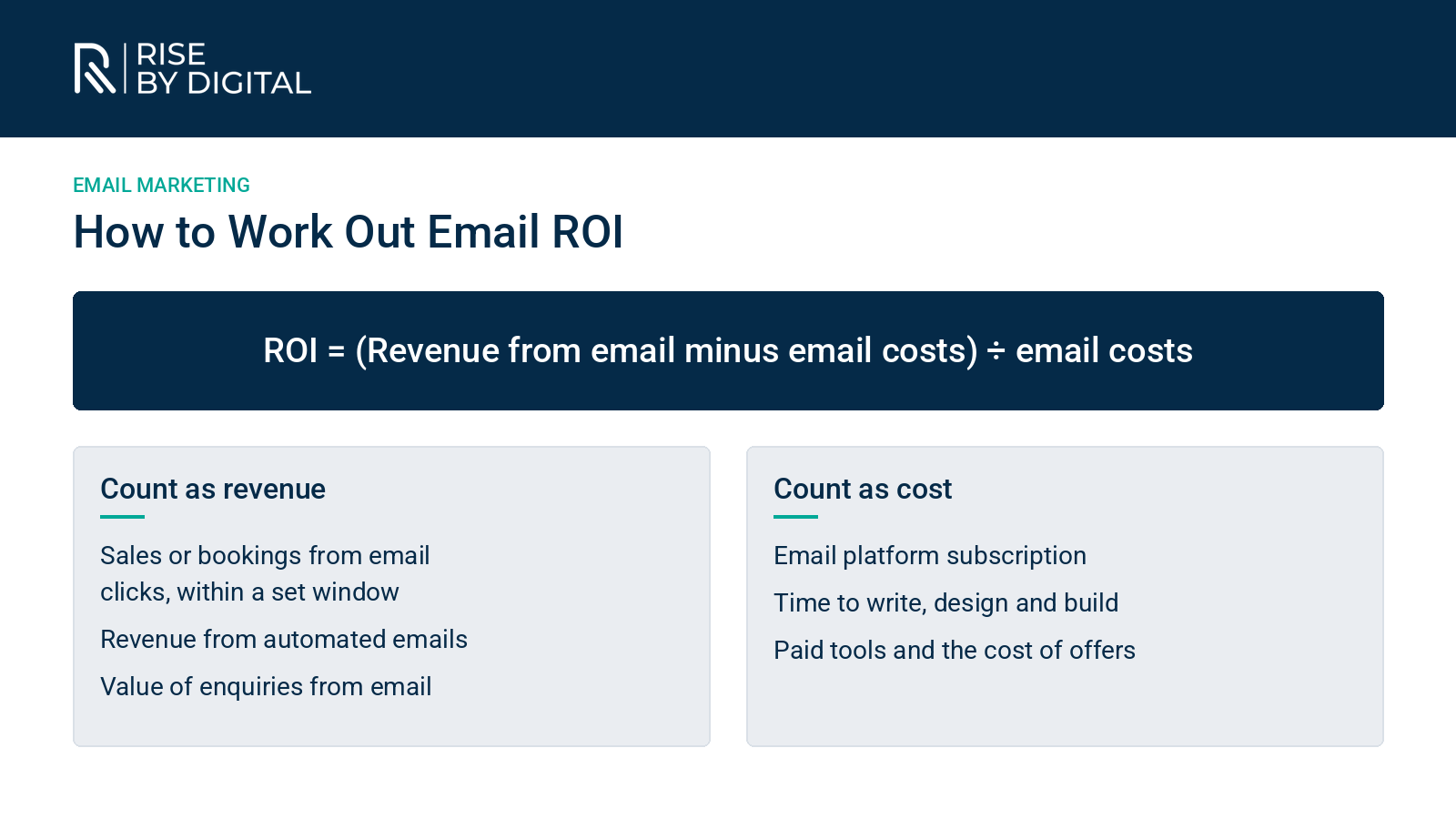
Email ROI formula with checklists of what to count as revenue and what to count as cost
3. Metrics That Matter More Than Opens
Open rates are no longer a reliable measure of success, and the DMA's own recommendations push marketers towards bottom-funnel measures such as revenue attribution, customer lifetime value and purchase behaviour. The DMA also suggests treating opens and clicks as signals of inbox health and basic relevance rather than proof of impact.
For a small business, focus on a short list:
• Revenue or enquiries per email sent.
• Conversion rate from click to sale or enquiry.
• Repeat purchase rate among subscribers compared with non-subscribers.
• List growth and unsubscribe rate, as signs of list health.
Pick one bottom-funnel metric and report it monthly. That is the number that will win the budget conversation.
4. Email Marketing vs Social Ads
Email and paid social are not really competitors. They do different jobs.
Paid social is good at reaching new people who do not know you yet. You pay for every impression or click, and costs move with the auction.
Email works best with people who already know you: past customers, enquirers and subscribers. You own the list, so you are not renting attention each time. That makes email strong for retention, repeat purchases and nurturing longer sales cycles.
A practical approach is to use ads to win new contacts and email to turn them into repeat customers. If your ads bring in leads that never hear from you again, that is often the cheapest improvement available. Our Black Friday and Christmas ads guide shows how the two work together during busy periods.
5. Stay Within UK Rules
A brief but important point. The ICO's guidance on electronic mail marketing says you must not send marketing emails to individuals without their specific consent, with a limited exception for your own previous customers, often called the soft opt-in. That exception applies when someone bought or negotiated to buy a similar product or service from you and you gave them a simple way to opt out when you collected their details and in every message.
The ICO also says you must not hide your identity and must give a valid address for people to unsubscribe. A clean, permission-based list is not just compliant; it is also the list most likely to deliver a real return.
6. When Email Is Worth More Investment
Email usually deserves more attention when:
• You have a list of past customers you rarely contact.
• Your products or services are bought more than once.
• Your sales cycle is long, so leads need several touches before they buy.
• You already pay to generate leads through ads or SEO and want more value from each one.
If you are starting from scratch, our guide to creating an engaging email marketing campaign covers the basics of planning and writing your first campaigns.
7. Your Email ROI Checklist
• Decide what counts as email revenue and your attribution window.
• List every cost, including time.
• Calculate ROI monthly using the same rules.
• Replace opens with one bottom-funnel metric in your reporting.
• Check your list meets consent and soft opt-in rules.
• Compare email's role with paid social: retention versus acquisition.
8. Find Out What Your List Is Worth
Email is still worth it for most UK businesses, provided you measure it properly and use it for the jobs it does best. If you would like help setting up automations, reporting and campaigns that show a clear return, plan your email strategy with us and our email marketing team will get in touch.
