
How discovery is splitting across Google, AI Overviews and assistants - and what marketers should do next without drowning in stats.
If you are planning SEO and content right now, you have probably felt the ground shift a little. Discovery no longer lives in one place. People still use Google, but they also get answers from AI Overviews and from assistants such as ChatGPT, Gemini and Grok.
I wrote this for marketers who want a clear read on what is actually changing - not another panic headline about the death of search. The classic blue-link journey still matters. It is just no longer the only useful journey, and plans that assume it is will miss how people find answers.
At Rise By Digital we work with 150+ clients across the UK, many of them East Midlands businesses who still need classic Google visibility and a plan for AI answers. This piece is for marketers first. I will keep it practical: what the big picture looks like now, what the published forecasts said, and what I think you should do next.
The current picture: Google still huge, AI search already real
Start with the simple split.
Sitefire's analysis of Similarweb daily web sessions for October to December 2025 puts traditional Google Search at about 95% of measured web sessions and all AI search engines combined at about 5%. Google is still the giant. AI search is no longer a rounding error either - it is already a meaningful slice, with ChatGPT leading that AI group.
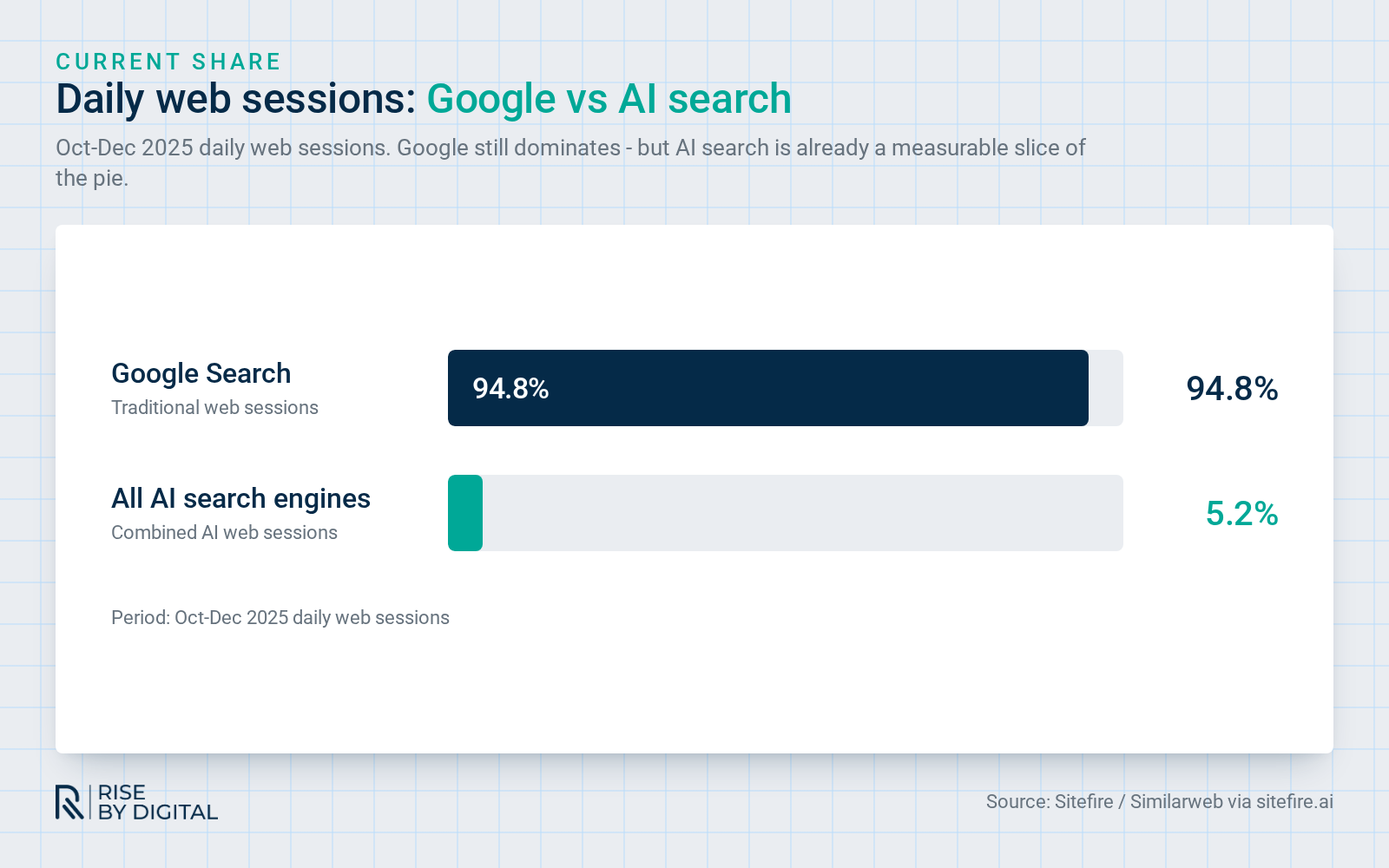
Source: Sitefire analysis of Similarweb daily web sessions, October to December 2025.
That is one lens. Graphite looks at relative size rather than only "did someone open google.com".
Graphite's research dated 5 March 2026 puts it like this. If traditional search engines had 100 monthly sessions, AI products together had about 56 worldwide. That is what "56% the size of search" means - relative volume, not "AI took 56% of Google's traffic". On a separate share-of-search measure in the same research, Google's share of search-related traffic worldwide fell from 89% in 2023 to 71% in Q4 2025, while ChatGPT sits at about 20% worldwide. Search itself was flat, not collapsing - the combined search-plus-AI pie grew. Search Engine Land summarised the Graphite study if you want a shorter read.
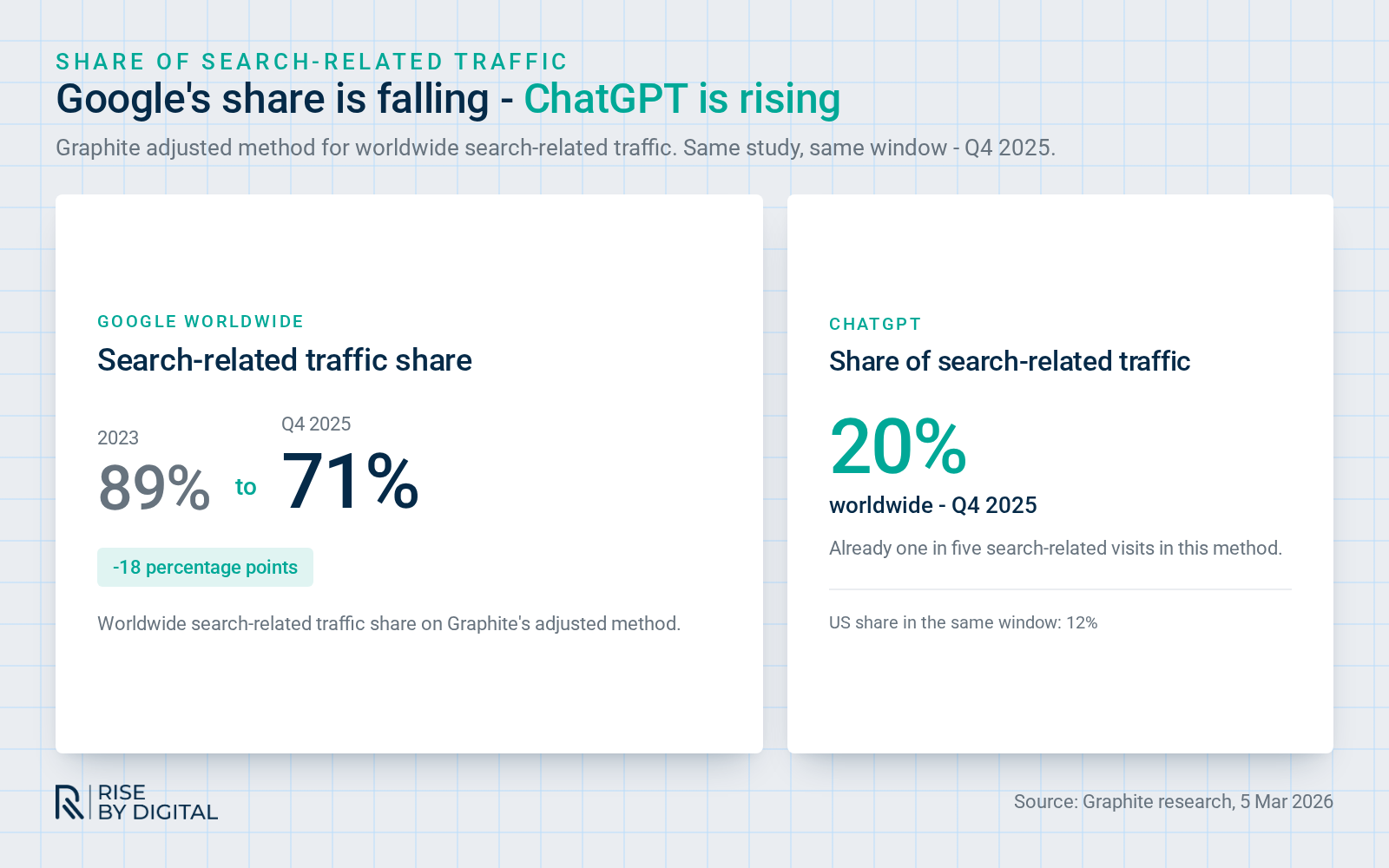
Source: Graphite research, 5 March 2026.
Inside the old "search engine" category, Google still looks almost total - the Datos / Semrush State of Search Q2 2026 still has Google in the low-to-mid 90%s for traditional desktop search. Outside that category, assistants are taking real discovery share.
Inside Google, AI Overviews already change what a search feels like. Semrush's AI Overviews study found AIO coverage was volatile through 2025 - and the story is not a simple "every Overview kills every click". Separately, Semrush's AI SEO statistics round-up cites Pew that far fewer people click a traditional result when an AI summary appears. Attribute those Bain and Pew figures to Semrush's citation, not to a Rise By Digital primary study.
The next ~6 months: my outlook (not a made-up percentage)
Here is the honest line. I have not seen a credible published forecast that pins a neat near-term percentage drop on traditional Google volume. I will not invent one.
What I do think, as someone who lives in client SEO, paid search and content every week, is that the next few months are when habits tip for a lot of marketers' audiences:
- More people ask ChatGPT, Gemini or Grok first for explainers, comparisons and "what should I do" questions
- More Google results include AI Overviews or push people toward AI Mode style experiences
- More of the journey ends without a classic blue-link visit, even when Google is still "in the mix"
Semrush's AI search SEO traffic study notes the shift can happen sooner if Google's default becomes AI Mode. That is why I am urgent about the next half-year - defaults and habits move faster than annual planning cycles.
If you wait for a perfect industry chart that proves the tipping point after the fact, you will brief 2027 work with 2024 assumptions.
Gartner's 2026 forecast - and what measured data shows now
Gartner's 19 February 2024 press release predicted that by 2026, traditional search engine volume will drop 25%.
That was a 2024 prediction aimed at a 2026 horizon. We are now in that window, so I treat it as a forecast whose deadline has arrived - not as a fresh "look ahead" for next year.
In July 2026, Fractl and Search Engine Land published a measured check (data as of April 2026). Across a large set of high-volume keywords, about 29% of that tracked volume was in measurable decline - a little above Gartner's 25%. Growing keywords almost exactly offset the declining ones, so net demand across the set was essentially flat. The story is redistribution, not the death of search.
Their consumer survey fits the same picture: most people say they use AI tools more than a year ago, while only about 17% say they use traditional search less.
That does not mean Google disappears. It is a shift in where demand shows up. If your reporting still treats organic Google sessions as the only proof that content worked, you will under-read demand that now shows up as assistant answers, branded direct visits after an AI recommendation, or shorter assisted paths.
A couple of years out: early 2028 for some topics
Still looking forward, Semrush's AI search SEO traffic study (July 2025) remains a published forward forecast. For the digital marketing and SEO topics they modelled, AI search visitors may surpass traditional search visitors by early 2028 - and sooner if AI Mode becomes the Google default. In the same study, the average LLM visitor was worth about 4.4x a traditional organic visitor.
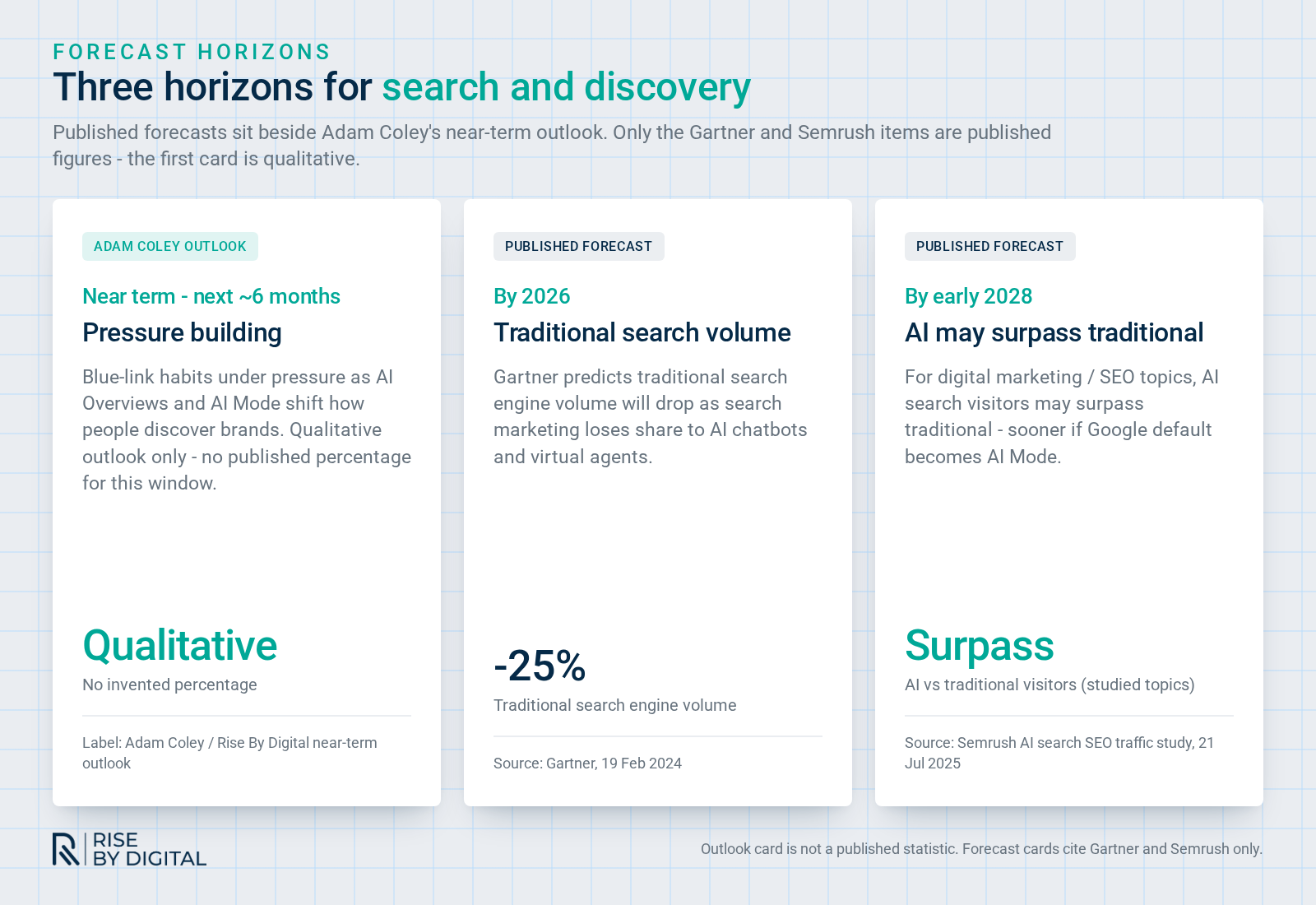
Sources: Adam Coley / Rise By Digital near-term outlook (qualitative); Gartner press release 19 February 2024; Fractl / Search Engine Land measured check, 2 July 2026 (data as of April 2026); Semrush AI search SEO traffic study, 21 July 2025.
Read that as a planning signal for marketers in competitive knowledge categories, not as a promise that every local plumber's traffic flips on the same date. The direction is clear enough to change how you brief content, PR and measurement this year.
What this means for marketers (SEO, AEO and the work that still needs humans)
I still want strong technical SEO, clean site structure and pages that earn clicks. That has not gone away. What has changed is the job description around it.
1. Optimise for answers as well as rankings. We have written before about SEO vs AEO vs GEO. The practical version: clear entities, quotable facts, original experience, and pages that an assistant can trust enough to cite.
2. Stop treating AI copy as a finished product. Assistants reward specificity and lived detail. That is why AI content still needs human creativity is a visibility line, not just a branding one.
3. Measure discovery, not only last-click organic. Watch branded search, direct, assisted conversions, and "how did you hear about us" answers. Build a simple Live Dashboard view that includes what sales hears - not only sessions from google / organic.
4. Use AI tools without losing judgement. We use AI agents heavily ourselves - including Grok Bot for the busywork - so humans can spend time on strategy and creative. Speed is useful. Unchecked publishing is not.
5. Brief campaigns for two surfaces. Paid and organic still need a strong landing page. They also need a crisp, factual story that can survive being summarised by Gemini or ChatGPT.
A practical 90-day checklist
If you only do a few things after this post, start here:
- Check your top money queries in Google, AI Overviews, ChatGPT, Gemini and Grok.
- Tighten the pages that should be cited - clear answers, proof, updated dates.
- Align PR and LinkedIn with the same facts you want assistants to repeat.
- Agree how you will report AI-influenced demand to leadership, even if the analytics are imperfect.
That is enough to move while discovery keeps splitting.
Where to take this from here
The shift is already visible. Gartner's 2026 horizon is a prediction we can check against measured data, and Semrush's early 2028 forecast is still ahead of us. My ask is simpler: treat the next few months as preparation time, not panic time - and build a marketing system that still works when the answer is an AI summary instead of a blue link.
If you want a second pair of eyes on how your current methods and processes line up with that picture - what still works in traditional search, where AI answers already matter for your topics, and what to tighten first - we can walk through it with you at Rise By Digital. Call 01509 357412 or get in touch via risebydigital.com.
