
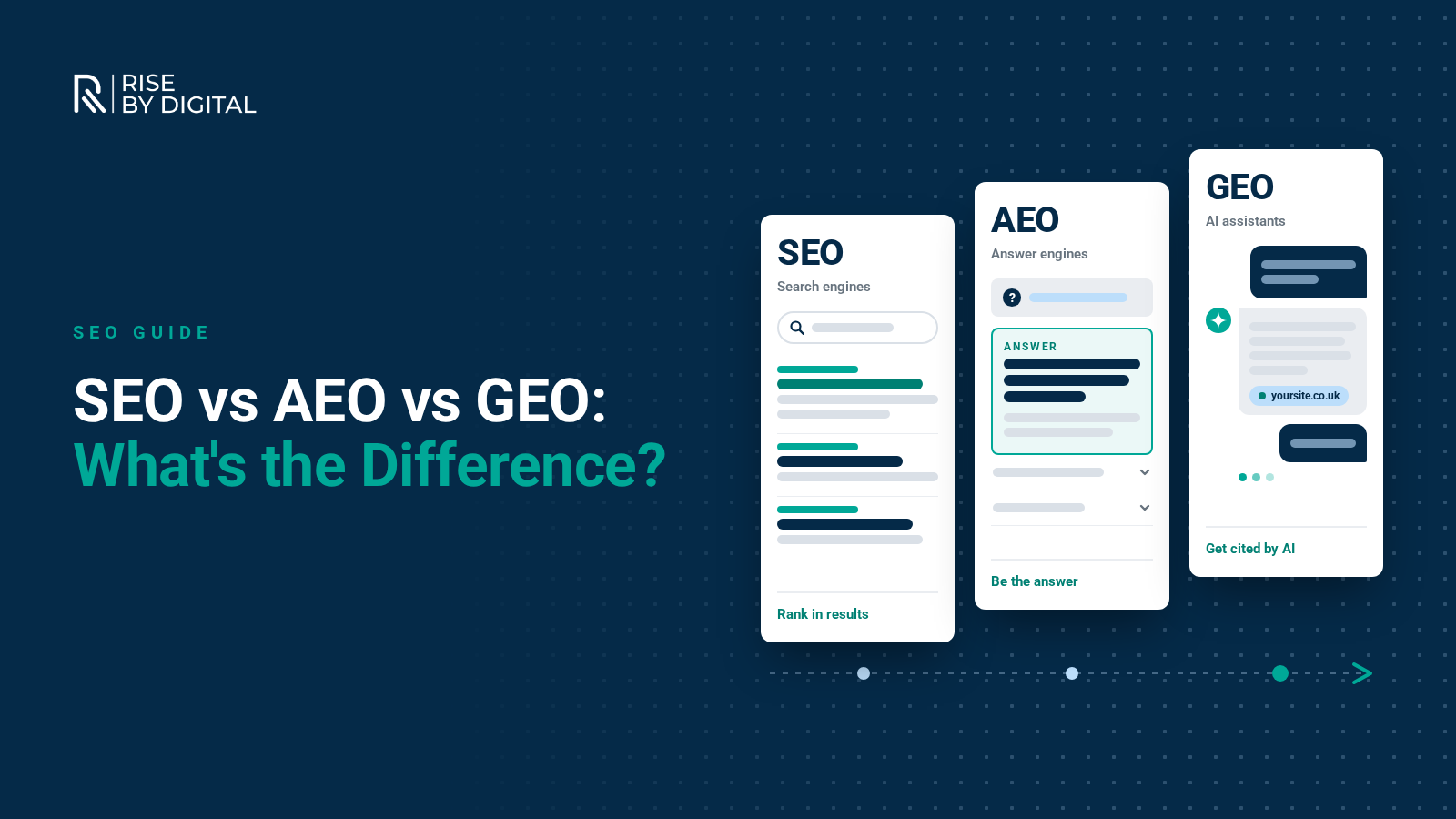
SEO gets you found, AEO gets you chosen as the answer and GEO gets you cited by AI. Here is what each term really means, what Google says about AI search, and how to optimise for all three.
Search used to mean one thing: typing a query into Google and clicking one of ten blue links. Now the same question might be answered by an AI Overview at the top of Google, a conversation in AI Mode, a voice assistant, or a chatbot such as ChatGPT or Perplexity. Each of these can send you customers, and each picks its sources in slightly different ways.
That is why you are hearing three acronyms: SEO, AEO and GEO. They are often presented as competing strategies. They are not. They are three layers of the same goal, which is making sure your business is the trusted source behind the answer, wherever the question is asked.
Here is the short version. SEO helps you get found. AEO helps you get chosen as the answer. GEO helps you get cited by AI. The rest of this guide explains what each means, what actually works and how to put it into practice.
What is SEO?
SEO stands for search engine optimisation. It is the work of making your website easy for search engines to crawl, understand and index, and useful enough to rank for the searches your customers make. Google's own Search Central documentation is the best primary reference.
Traditional SEO covers:
- Technical health: crawlability, indexing, site speed, mobile usability and clean site structure.
- Keyword and intent research: understanding what people search for and why.
- On-page optimisation: titles, headings, content and internal links that match that intent.
- Content quality: genuinely helpful pages that answer questions better than the alternatives.
- Authority: links and mentions from other reputable sites.
- Local signals: an accurate Google Business Profile and reviews, if you serve a local area (see our guide to local SEO).
The goal is visibility and clicks from organic search results. Everything else in this article builds on it.
What is AEO?
AEO stands for answer engine optimisation. It is an industry term rather than an official Google one, but the idea is simple. More and more searches end with a direct answer rather than a list of links, through featured snippets, People Also Ask boxes, voice assistants and AI Overviews. AEO is about structuring content so it can be lifted out and presented as that answer.
AEO tends to prioritise:
- Question-led headings that match how people actually phrase queries.
- A concise answer first, ideally in the first sentence or two under the heading, then the detail.
- Clear structure: short paragraphs, lists, steps and tables where they help.
- Definitions and comparisons written in plain language.
- Accurate, sourced facts that can be trusted out of context.
A note on FAQ schema
Many AEO guides still recommend FAQ structured data as a shortcut. Since August 2023, Google has shown FAQ rich results only for well-known, authoritative government and health websites. FAQ sections are still useful for readers and for clarity, but most businesses should not expect FAQ schema to produce special search features.
AEO does not replace SEO. A page has to rank, or at least be indexed and trusted, before it can be chosen as the answer.
What is GEO?
GEO stands for generative engine optimisation. The term was popularised by a 2023 research paper, GEO: Generative Engine Optimization, by researchers from Princeton University and other institutions, later published at the KDD 2024 conference. It describes improving the chance that your content is used and cited in responses generated by AI systems, such as Google's AI Overviews and AI Mode, ChatGPT, Perplexity and Microsoft Copilot.
Unlike classic SEO, GEO is less about one page ranking in one position and more about being included in a synthesised answer that may draw on several sources. The paper's experiments found that adding citations, quotations from relevant sources and statistics improved visibility in generative responses by up to 40% on its test set, while traditional keyword stuffing did not help. Those results come from a research benchmark rather than live search, but they point in a sensible direction.
Signals that are likely to matter for GEO include:
- Topical authority: covering a subject in depth across related pages.
- Entity clarity: making it obvious who you are, what you do and where, consistently across your site and the web.
- Original information: first-hand experience, data, examples and clear definitions others do not have.
- Third-party mentions: reviews, press coverage and citations on reputable sites.
- Clear, quotable writing that makes sense when a sentence is lifted out of context.
What Google actually says about AI search
It is easy to get swept up in new acronyms, so it is worth hearing directly from Google. Its guidance on AI features and your website says:
- The best practices for SEO remain relevant for AI Overviews and AI Mode.
- There are no additional requirements or special optimisations needed to appear in them.
- To be shown as a supporting link, a page must be indexed and eligible to appear in Search with a snippet.
- You do not need new machine-readable files, "AI text files" or special schema.
- Traffic from AI features is included in Search Console's Performance report under the "Web" search type.
In the UK, AI Overviews are now a familiar sight, and Google launched AI Mode in the UK in July 2025. Google also explains that these features can use "query fan-out", running several related searches across subtopics to build a response. In practice, that rewards sites that cover a topic thoroughly rather than a single keyword.
The takeaway: be wary of anyone selling a secret AI ranking trick. Strong SEO, helpful content and a trusted brand are the foundation for all three.
SEO vs AEO vs GEO at a glance
- SEO: goal is to rank and earn clicks from search results. Measured through rankings, impressions, clicks and conversions.
- AEO: goal is to be selected as the direct answer. Measured through featured snippets, People Also Ask appearances and visibility for question queries.
- GEO: goal is to be cited or mentioned in AI-generated responses. Measured through brand mentions and citations in AI tools, referral traffic from AI platforms and branded search growth.
SEO is the base layer. AEO sharpens your content so it can be extracted cleanly. GEO extends your reach into AI-generated answers, which depend heavily on the same signals of quality and trust.
How to optimise for all three
The smartest strategy is one joined-up plan, not three separate projects.
1. Fix the SEO foundations
Make sure your site can be crawled and indexed, loads quickly and has a clear structure with sensible internal links. Check that robots.txt and your hosting or CDN are not blocking search engines. Google Search Console will flag many issues for free.
2. Build pages around real questions
Use customer conversations, sales calls and search data to list the questions people actually ask. Give each important question a clear heading and a direct answer, then expand with detail, examples and next steps.
3. Add what only you can say
Include first-hand experience, real examples, your own data and named experts. This is what makes content worth citing and very hard for competitors or AI tools to replicate. It is also central to Google's people-first content guidance.
4. Make your brand easy to understand
Keep your business name, services, locations and contact details consistent across your website, Google Business Profile, directories and social profiles. Use an About page and author bios that explain real expertise.
5. Earn mentions elsewhere
Reviews, press coverage, partnerships, guest articles and industry directories all help search engines and AI systems understand that others trust you.
6. Measure the whole picture
Track organic clicks and conversions in Search Console and GA4, watch for referral traffic from AI platforms, and regularly test how your brand appears when you ask AI tools about your services.
A practical page template
- Start with a direct answer near the top.
- Expand with definitions, examples and comparisons.
- Use question-style subheadings.
- Include original insight, data or a real example.
- Cite reputable sources for any facts.
- Finish with a clear next step for the reader.
That gives search engines something to rank, answer engines something to extract and generative engines something worth citing.
Frequently asked questions
Final takeaway
SEO, AEO and GEO are not competing disciplines. They are three layers of modern search visibility. If SEO is about being found, AEO is about being selected and GEO is about being cited.
The future is not less search. It is broader search, with more interfaces, more summaries and more competition to become the trusted source behind the answer. Businesses that invest in solid foundations and genuinely useful content now will be ready for whichever interface their customers use next.
If you want to know where your site stands, our SEO team can review your technical health, content and visibility across traditional and AI search, and show you what to prioritise. Prefer to build skills in-house? Our SEO training covers the fundamentals and AI search in practical sessions.