
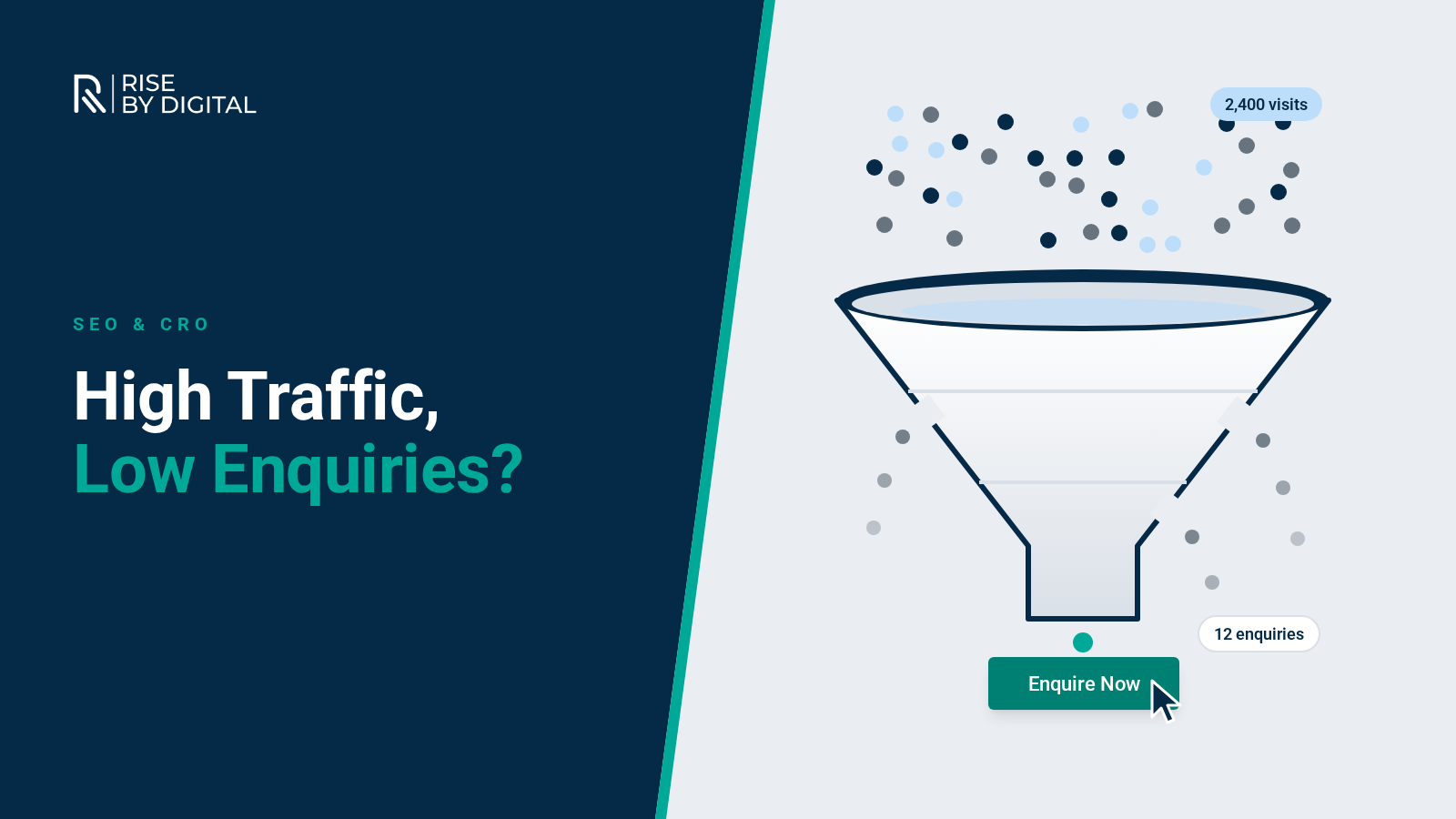
Traffic is up but the phone is quiet? You have a leaky bucket. Here are the four places websites usually lose enquiries, how to find your biggest leak and a practical checklist to fix it.
You check Google Analytics on a Friday afternoon. Traffic is trending up, your SEO work seems to be paying off and your ads are getting clicks. Then you look at the inbox. Nothing. The phone has not rung all week.
It is one of the most common frustrations we hear from SME owners, and it is an expensive one. Every visitor who leaves without acting is money spent on attention that went nowhere. In some cases, it is worse than that: you have done the hard work of educating a prospect, and they go on to buy from a competitor whose website made it easier to say yes.
High traffic with no enquiries does not mean your marketing is working. It means you have a leaky bucket. The good news is that the leaks are usually in the same handful of places, and most can be fixed without rebuilding your whole site.
First, make sure the problem is real
Before changing anything, check that you are measuring properly. We regularly audit sites where enquiries are coming in but are not being tracked, so the business thinks conversion is far worse than it is.
- Are your key actions tracked? In GA4, form submissions, phone clicks, email clicks and bookings should be set up as key events, so you can see which pages and channels drive them.
- Do forms actually work? Submit your own forms on desktop and mobile. Check the emails arrive and do not land in spam.
- Is the traffic real? A spike from one country, one referrer or with near-zero engagement time is often bots, not buyers.
Once you trust the numbers, you can find the leaks. In our experience, they fall into four groups.
1. You are attracting the wrong audience
Not all traffic is equal. If your SEO or Google Ads strategy chases broad, high-volume search terms, you will get visitors, but many of them were never going to buy.
The problem
Informational keywords bring researchers, not buyers. An accountancy firm that ranks for "how to calculate tax" will attract students and DIYers. One that ranks for "small business accountant in Leicester" attracts people with a budget and a need.
The fix
- Map keywords to intent. Separate informational terms (how, what, why) from commercial ones (service plus location, "near me", "cost", "quote", "agency"). Make sure your money pages target the commercial terms.
- Use informational content deliberately. Guides are valuable, but each one should link clearly to the relevant service page so researchers have a next step when they are ready.
- Check your search terms report. In Google Ads, review the actual searches triggering your ads and add negative keywords for anything irrelevant. It is one of the quickest ways to stop wasted spend.
If you are unsure which of your pages attract buyers and which attract browsers, an SEO audit will usually show it quickly.
2. Your website is a brochure, not a salesperson
Many business websites look good but do not guide anyone towards a decision. They describe the company instead of answering the visitor's question: can you solve my problem, and what do I do next?
Vague messaging
Visitors make up their minds fast. Research summarised by Nielsen Norman Group found that the first 10 seconds of a page visit are critical to whether people stay or leave, so your value proposition needs to be clear almost immediately. "Synergistic digital solutions" tells a visitor nothing. "We help East Midlands businesses get more enquiries from their website" tells them exactly whether they are in the right place.
A useful test: show your homepage to someone outside your business for five seconds, then ask what you do, who it is for and what they should do next. If they cannot answer all three, your headline and hero section need work.
Passive calls to action
A "Contact us" link in the footer is not a call to action. Every key page needs one clear next step, visible without scrolling and repeated further down for people who read more first.
- Use specific button text: "Get a quote in 24 hours" beats "Submit".
- Offer a lower-commitment option alongside the main one, such as a guide, a price list or a short call.
- Remove competing buttons that pull attention in different directions.
3. You are missing trust signals
People rarely hand money to a business they know nothing about. If your site feels anonymous, visitors will look elsewhere, even if your service is better.
What to add
- Real reviews, close to the decision. Place Google reviews or testimonials next to your calls to action, not hidden on a separate page.
- Proof of results. Case studies with a clear problem, what you did and what changed. Our own work page is built around this.
- Faces and names. A team page and real photography make a business feel accountable.
- Accreditations and memberships that your customers recognise, shown where they matter.
- Clear practical details: pricing guidance, service areas, response times and a physical address where relevant.
Trust is also about consistency. If your branding, tone and imagery feel mismatched across pages, it quietly undermines confidence.
4. There is too much friction in the journey
If someone decides they want to work with you, how hard is it to actually get in touch?
Forms that ask too much
Long forms asking for company size, budget, postal address and how you heard about us will lose people. Ask only for what you need to respond well, usually name, email or phone, and a short message. You can gather the rest on the first call.
Mobile frustration
Much of your traffic is likely to be on mobile. Check that phone numbers are tap-to-call, buttons are big enough to press, pop-ups do not block the screen and forms are easy to complete with a thumb.
Slow pages
Speed affects whether people stay long enough to read your message. Google's Core Web Vitals give clear targets: the main content should load within 2.5 seconds, the page should respond to taps within 200 milliseconds and the layout should not jump around as it loads. You can check your scores for free in PageSpeed Insights or Search Console. Our guide to website speed explains the common causes.
How to find your biggest leak
You do not need to fix everything at once. Start where the most money is being lost.
- In GA4, list your top landing pages by sessions and add their key event rates.
- Find pages with high traffic but few or no enquiries. These are your priority.
- Watch session recordings or heatmaps (tools such as Microsoft Clarity are free) to see where people hesitate or leave.
- Make one meaningful change per page, such as a clearer headline, a shorter form or reviews beside the button.
- Measure for a few weeks, keep what works and move to the next page.
Quick conversion checklist
- Key actions are tracked as key events in GA4 and tested.
- Money pages target commercial, high-intent keywords.
- Your headline says what you do, for whom, and what to do next.
- Every key page has one clear, specific call to action above the fold.
- Reviews and proof sit next to the decision point.
- Contact forms ask only for essentials.
- Phone numbers are tap-to-call and the site works well on mobile.
- Core Web Vitals are in the "good" range.
Turn traffic into enquiries
Your website should be your hardest-working salesperson, available around the clock. More traffic only helps if the site is built to convert it.
At Rise By Digital, our UX and CRO reviews look at your site the way a potential customer does, then back it up with data on where people drop off. Where the fix needs design or development work, our website design team can carry it through, and our SEO and PPC specialists make sure the right people are arriving in the first place.