
AI can draft content in seconds, but it can't supply your experience, opinions or brand voice. Here is where AI helps, where it falls short, what Google says, and a practical human-led workflow.
AI has changed how marketing content gets made. A caption that once took twenty minutes now takes twenty seconds. Blog outlines, email subject lines, ad variations and campaign ideas can all be drafted almost instantly. For small marketing teams, that is a genuine gift.
But AI has not changed what audiences want. People still respond to brands that sound like someone, know something and say it in a way that feels relevant to them. As more businesses publish AI-assisted content, the internet fills up with posts that are polished, plausible and almost identical. The risk is not that AI content is bad. The risk is that it is average, and average is easy to scroll past.
The businesses getting the most from AI are not choosing between technology and creativity. They are using AI for speed and keeping people firmly in charge of the ideas, the voice and the judgement. Here is how that works in practice.
What AI is genuinely good at
It is worth being clear about where AI earns its place, because dismissing it is as unhelpful as over-relying on it.
- Getting past the blank page. Ten headline options or a rough outline can unlock a stuck writer.
- Repurposing. Turning a long article into social posts, an email and a short video script.
- Variations for testing. Several versions of an ad or subject line so you can test more ideas.
- Summarising and structuring notes, transcripts and research.
- Checking and tidying grammar, clarity and reading level.
Used like this, AI frees up time for the work that actually differentiates you: strategy, original thinking and making content that connects.
What AI cannot do on its own
Large language models work by predicting likely words based on patterns in the material they were trained on. That makes them excellent at producing the most typical answer to a prompt. It also explains their main weaknesses.
It does not know your business
AI has no idea what your customers asked last week, which objections come up on sales calls, or what makes your service different from the agency down the road. Unless someone gives it that context, it fills the gap with generic statements that could apply to anyone.
It does not have experience
The most valuable content usually comes from things that happened: a campaign that worked, a mistake you learned from, a pattern you have noticed across clients. AI can help you write those stories up, but it cannot live them for you.
It can be confidently wrong
AI tools can produce statistics, quotes and sources that sound credible but do not exist. Publishing them damages trust quickly. Every factual claim needs checking against a reliable source before it goes out.
It drifts towards sameness
Left to itself, AI favours familiar phrases and safe opinions. Readers may not consciously spot that a post was AI-written, but they notice when it feels like everything else in their feed.
What Google says about AI content
Many business owners worry that AI content will be penalised in search. Google's position is more nuanced. In its guidance on AI-generated content, Google says it rewards high-quality content "however it is produced", and judges content on qualities it calls E-E-A-T: experience, expertise, authoritativeness and trustworthiness.
However, Google's spam policies treat "scaled content abuse", producing lots of pages mainly to manipulate rankings with little value for readers, as a violation however the content is made. In other words, AI is not the problem. Thin, mass-produced content is. The same people-first standards apply either way, and those standards favour first-hand experience and original insight, which is exactly what humans bring. We explain how this links to visibility in AI search in our guide to SEO, AEO and GEO.
Brand voice is where the human work shows
A consistent voice helps people recognise your business everywhere, from a LinkedIn post to a quote email. It is also one of the first things to slip when AI does too much of the writing.
AI-written copy often uses phrases your team would never say, swings between formal and casual, or adopts an upbeat tone that does not suit a sensitive subject. Over months, those small inconsistencies blur what your brand sounds like.
Give AI a proper brief
You can reduce this significantly by giving AI tools better instructions. A simple voice guide should include:
- Three to five words that describe your tone, with a short example of each.
- Words and phrases you always use, and ones you never use.
- British English spelling and any house style rules.
- Two or three examples of past content you are proud of.
- Who you are writing for and what they care about.
Even with a strong brief, a person who knows the brand should edit every piece before it is published. AI can draft. People make it sound like you.
Original ideas still win
AI is very good at summarising what already exists. That is precisely why it struggles with thought leadership. If an article could have been written by anyone with access to the same tool, it gives readers no reason to choose you.
Content that stands out tends to include things only your business can provide:
- Real examples from your own work, with permission where needed.
- Opinions you are prepared to defend, including where you disagree with common advice.
- Data from your own customers, campaigns or surveys.
- Behind-the-scenes detail about how you work and why.
This is also why authenticity performs so well on social channels at the moment, a trend we covered in why authentic content is winning on social media.
Strategy comes before content
Producing more content does not automatically produce more results. Before anyone writes a blog, records a video or schedules a post, someone needs to answer:
- Who are we trying to reach?
- What problem are they trying to solve?
- Where are they in the buying journey?
- What do we want them to do next?
AI can help answer some of these with research, but it cannot decide your commercial priorities. Without that direction, even well-written content tends to drift.
A practical human-led, AI-assisted workflow
This is broadly how we approach it with clients:
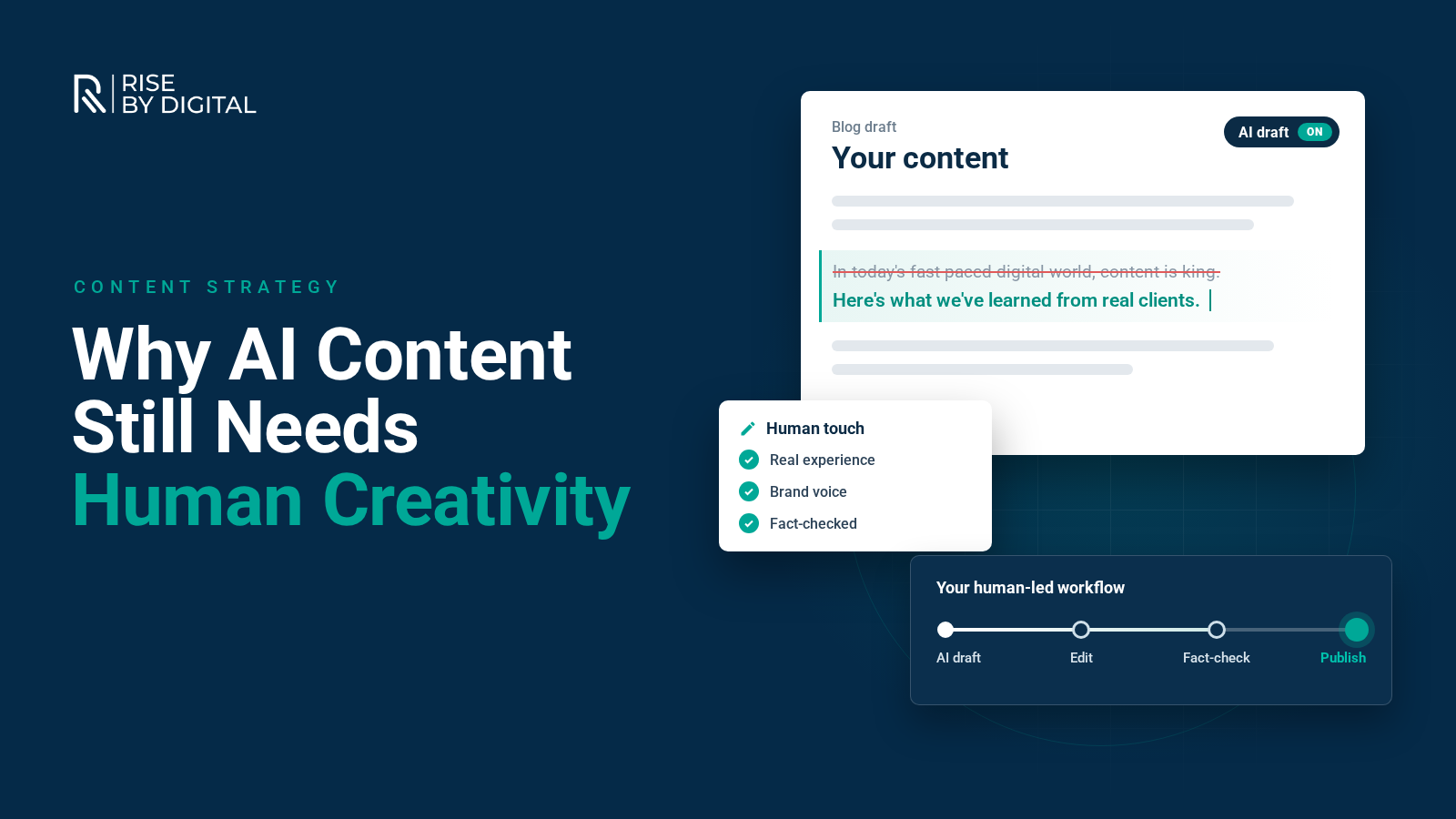
- Human: strategy and brief. Define the audience, the goal, the angle and the key points only you can make.
- AI: research support and outline. Use AI to suggest structures, questions to answer and gaps to cover.
- Human: add the substance. Insert real examples, opinions, data and expert input.
- AI: drafting help. Expand sections, suggest alternatives and tighten wording.
- Human: edit and fact-check. Check every claim, rewrite in your voice and cut anything generic.
- Human: final sign-off. Someone accountable approves it before it goes live.
The people sit at the start and the end, and they own the parts that matter most.
Quick checklist before you publish AI-assisted content
- Does it say something a competitor could not easily copy?
- Does it include at least one real example, opinion or piece of data from your business?
- Have all facts, figures and sources been checked?
- Does it sound like your brand when read aloud?
- Is it written for a specific reader with a clear next step?
- Would you be happy putting a named person's byline on it?
Human-led, AI-assisted
AI will keep improving, and businesses that ignore it will fall behind on speed. But the brands that win will not be the ones publishing the most AI content. They will be the ones using AI to free up time for better thinking, clearer stories and more genuine connection.
At Rise By Digital, we use AI to speed up research and production where it helps. Every piece of content we create is still shaped by people who understand your brand and your commercial goals. If your own team wants to use AI more effectively, our training and AI consultancy sessions cover practical workflows, prompting and quality control.