
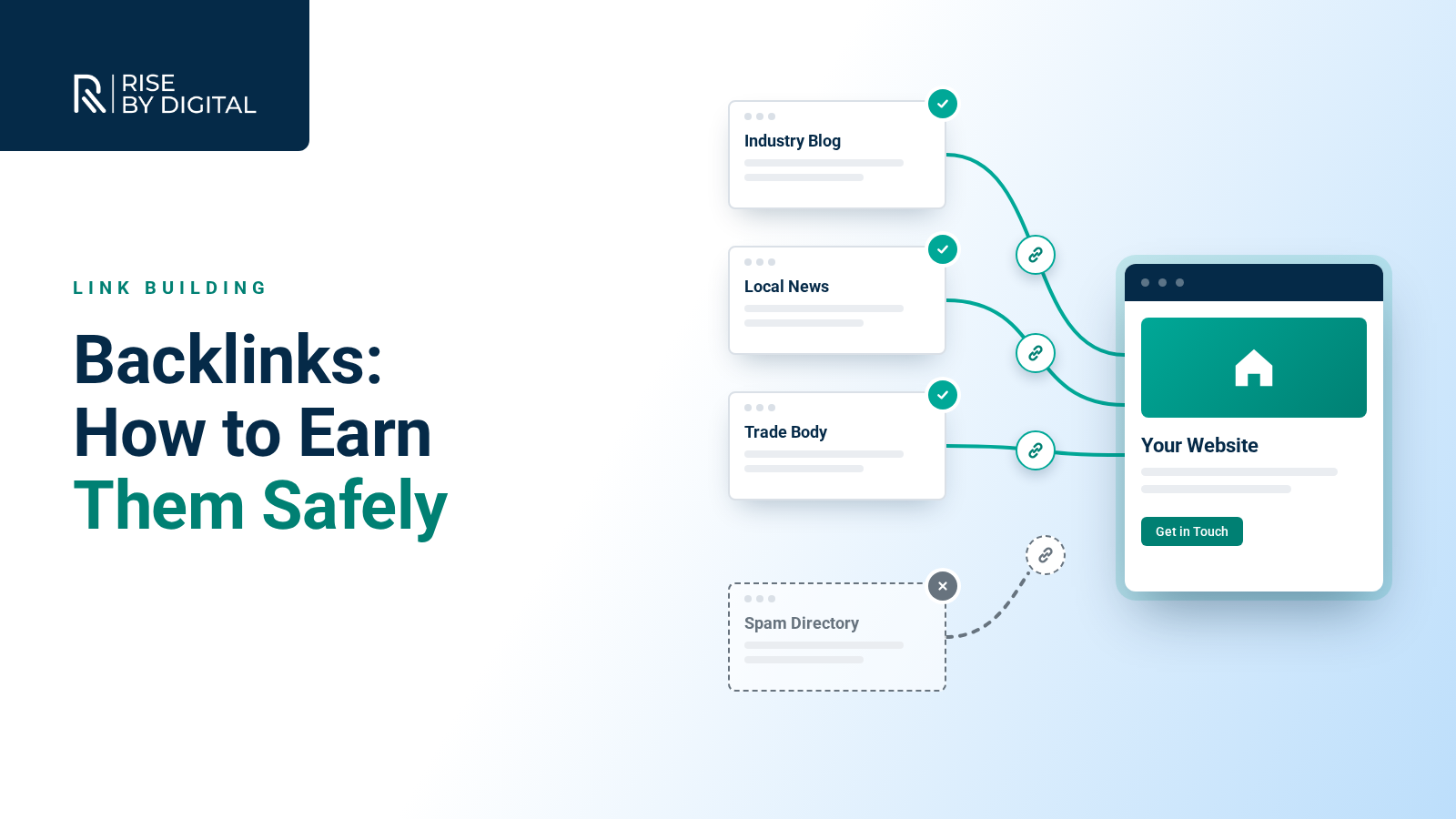
What backlinks are, why they still matter, how to tell good links from bad and the safe ways to earn them within Google's spam policies, with a simple checklist.
Backlinks are links from other websites to yours. They have been part of how Google understands the web since its earliest days, and they still matter. What has changed is how you should go about earning them. Many tactics that were once common, including some in the 2021 version of this article, now break Google's spam policies.
This guide explains what backlinks are, why they matter, how to tell a good link from a bad one and the safe ways to earn links as a small or medium-sized business.
What is a backlink?
A backlink is simply a link on another website that points to a page on yours. If a local newspaper writes about your business and links to your website, that is a backlink. So is a link from a supplier's "where to buy" page, a trade association directory or a blog that recommends your guide.
The clickable words in the link are called anchor text. Google explains that anchor text tells people and Google something about the page being linked to.
Why backlinks matter
Links help Google discover pages and understand which content other people find useful. Google's SEO Starter Guide notes that PageRank, which uses links, is one of its fundamental algorithms, but also that it is just one of many ranking signals.
That balance is important. A handful of relevant links from respected sites can help good content get noticed. A large number of poor links will not make weak content rank, and may cause problems.
What makes a good backlink?
Ask these questions about any link:
- Is it relevant? A link from a respected site in your industry or local area means more than one from an unrelated site.
- Is it editorial? The best links are given because someone chose to reference your content, not because you paid or asked for a swap.
- Would real people click it? If a link could send you genuine visitors, it is likely to be a good one.
- Is the site trustworthy? Look for real content, real authors and a real audience.
You may come across scores such as Domain Authority. These are third-party metrics. Moz, which created Domain Authority, says it is not a direct ranking factor but a comparative score. Use such metrics as a rough guide only. Our article on what Domain Authority means explains more.
Safe ways to earn backlinks
1. Create content worth linking to
Useful guides, original research, local data, calculators, checklists and clear explanations attract links naturally. Ask what your customers and industry keep asking about, then answer it better than anyone else.
2. Use your real-world relationships
Most businesses already have relationships that can lead to legitimate links: suppliers, manufacturers, trade bodies, accreditation schemes, local business groups, charities you support and clients you have worked with. A genuine case study, partner listing or membership page is a natural link.
3. Get involved in local and industry news
Offer expert comment to local press and trade publications, share news about awards, community projects or new premises, and respond to journalists looking for sources. Coverage that includes a link is valuable; coverage without one still builds your reputation.
4. Claim unlinked mentions
Search for your business name. Where a site mentions you without linking, a polite email asking for a link to the relevant page often works.
5. Fix links that point to broken pages
If you have moved or deleted pages, other sites may be linking to addresses that no longer exist. Use the Links report in Search Console to find your most-linked pages, and redirect any old addresses to the most relevant current page.
6. Use reputable listings, not link directories
Listings on Google Business Profile, recognised trade associations and reputable local organisations help customers find you. Mass submissions to generic directories are a different matter, as Google's spam policies list low-quality directory or bookmark site links as link spam.
How to ask for a link without being spammy
Outreach works best when it is personal and useful to the other person. Keep emails short, explain who you are, point to the specific page you think their readers would value and say why. Never offer payment for a followed link, and do not send the same template to hundreds of sites. One thoughtful message to a relevant contact is worth more than a mass campaign, and it protects your reputation. If someone says no, or does not reply, move on rather than chasing repeatedly.
A good test before you send any request: would you be comfortable if a customer, a journalist or Google read the email? If the answer is yes, you are probably on the right side of the line.
What to avoid
Google's spam policies describe link spam as creating links mainly to manipulate rankings. Examples include:
- Buying or selling links that pass ranking credit, including swapping goods or services for links
- Excessive link exchanges ("link to me and I'll link to you")
- Paid articles, guest posts or press releases with keyword-stuffed links that pass ranking credit
- Automated programs or services that create links
- Low-quality directory or bookmark links
- Links hidden in widgets, footers or templates across many sites
We have removed two tips from our original article for this reason. We previously recommended applying to free online directories and suggesting link swaps. Generic directories and excessive exchanges both fall within Google's examples of link spam.
Paid and sponsored links done properly
Sponsorship, advertising and influencer partnerships are fine. The links just need to be marked correctly. Google asks for rel="sponsored" on paid placements, with nofollow still acceptable, and rel="ugc" for user-generated links such as comments.
What about bad links pointing to your site?
Almost every site picks up some spammy links over time. In most cases, Google simply ignores them. Our original article suggested disavowing these links routinely. That was poor advice: Google describes the disavow tool as an advanced feature that should only be used with caution, mainly where you have a manual action for unnatural links, or are at real risk of one. Disavowing also does not remove links; it asks Google not to take them into account.
If you are worried, check the Manual actions report in Search Console first, then read our guide to disavowing poor-quality backlinks before acting.
How long does link building take?
Earning links is gradual, and results depend on your market and starting point. Google says changes to your site can take anything from a few hours to several months to be reflected in search. Think of link earning as part of an ongoing SEO plan, not a one-off project. Our guide to why SEO is a great investment covers realistic expectations.
Backlinking checklist
- Your best content and services have pages worth linking to
- Supplier, partner, membership and accreditation links checked and up to date
- Local press and trade media contacts listed and approached with real news
- Unlinked mentions found and followed up
- Broken pages with existing links redirected
- No paid, swapped or directory links that pass ranking credit
- Sponsored links marked with rel="sponsored"
- Manual actions report checked before considering a disavow
SEO at Rise By Digital
Link earning is one part of a wider plan that includes technical health and content. Our SEO packages include backlinking alongside technical SEO, content and reporting, starting from £179 a month for local SEO on a 24-month term, at the time of writing. We only use methods that sit within Google's guidelines.