
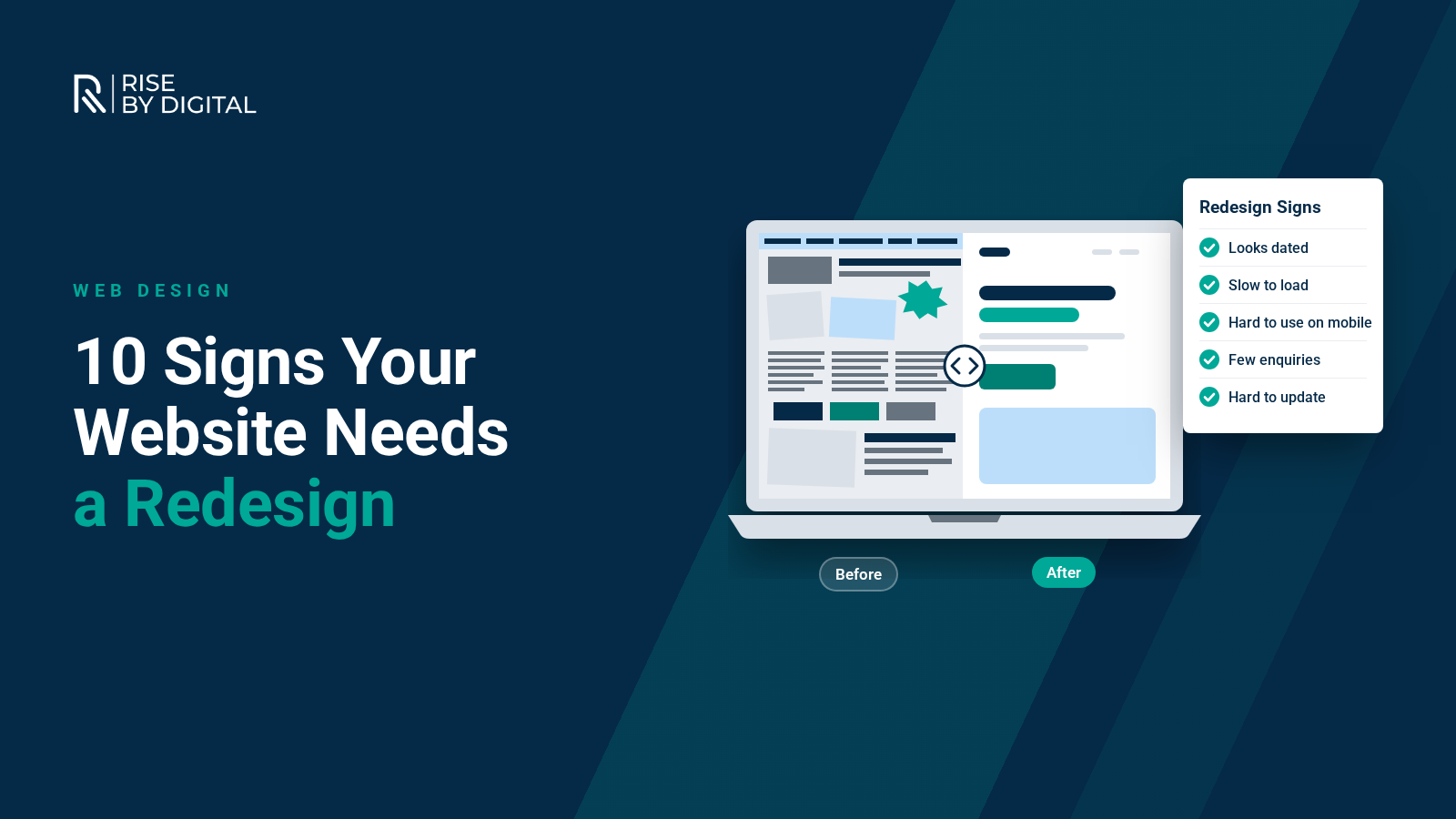
Ten signs your website needs a redesign, a quick checklist to score your current site and how to redesign without losing your search rankings.
Your website is often the first proper look a potential customer gets at your business. Social media, ads and word of mouth all send people there, and they decide quickly whether you look credible, relevant and easy to deal with. So how do you know when your current site has stopped doing its job?
There is no fixed lifespan for a website. Some sites work well for years with steady updates; others fall behind within months because the business, the technology or customer expectations change. Rather than redesigning on a schedule, look for the signs below.
Redesign, refresh or fix?
Not every problem needs a new website. It helps to separate three levels of work:
- Fixes: broken links, slow images, out-of-date pages, a missing call to action. These can often be done in days.
- Refresh: new copy, photography, page layouts or navigation on the same platform and structure.
- Redesign: a new design, structure and often a new platform, usually because the current site cannot support where the business is going.
Be honest about which one you need. A refresh is cheaper and faster, but if the platform itself is the problem, you will end up paying twice.
10 signs it is time to redesign your website
1. It is hard to use on a phone
Many visitors will see your site on a mobile first. Google also uses the mobile version of your pages for indexing and ranking (Google: mobile-first indexing). If text is tiny, buttons are fiddly or menus break on small screens, that is a priority.
2. It is slow
Check your key pages in PageSpeed Insights and the Core Web Vitals report in Search Console. Google's Core Web Vitals measure loading (LCP, aim for 2.5 seconds or less), responsiveness (INP, aim for under 200 milliseconds) and visual stability (CLS, aim for under 0.1). INP replaced the older FID metric in March 2024, so a site built before then may never have been tested against it. Our guide to website speed explains the common fixes.
3. You get traffic but few enquiries
If people are arriving but not calling, booking or buying, the site is not doing its job. Unclear messaging, weak calls to action and long forms are common causes. Our article on why website visitors aren't converting shows how to find the leak before you redesign.
4. You get very little traffic
If nobody can find you, the problem may be technical SEO, thin content or a structure that search engines struggle to understand. A redesign is a good moment to fix all three. Start with an SEO audit so the new site solves the right problems.
5. Your business has changed
New services, a new target market, a merger or a change in pricing all mean your website may now describe a business that no longer exists. If your sales team keeps explaining things the website gets wrong, it is time.
6. Your brand has moved on
A new logo, colour palette or tone of voice that has been bolted onto an old site rarely looks right. A rebrand and a redesign usually work best together.
7. Updating it is a struggle
If changing a price or adding a team member means emailing a developer and waiting, you lose time and the content goes stale. A modern content management system should let you make everyday edits yourself.
8. Security and maintenance worries
Outdated plugins, unsupported themes or an old platform version create security risks and can break without warning. If your site cannot be safely updated, a rebuild may be the responsible choice.
9. It is not accessible
An accessible website works for more people, including those using screen readers, keyboard navigation or magnification. The current benchmark is WCAG 2.2. If you sell online to consumers in the EU, note that the European Accessibility Act has applied to e-commerce services since 28 June 2025. Older sites often fail on colour contrast, missing alt text and forms without proper labels.
10. Competitors look more credible
Look at the sites of the businesses you compete with for the same customers. If yours looks dated, harder to use or less trustworthy by comparison, customers will notice too.
Checklist: should you redesign?
Score your site against these. If you tick four or more, a redesign is probably worth exploring.
- Hard to use or read on a mobile.
- Key pages fail Core Web Vitals.
- Traffic is steady but enquiries are low.
- Little or no organic search traffic.
- Content describes services or prices you no longer offer.
- Branding does not match your current identity.
- You cannot easily update it yourself.
- The platform, theme or plugins are out of date.
- Obvious accessibility problems.
- It looks weaker than competitors' sites.
How to redesign without losing your rankings
A redesign can damage your search visibility if it is handled carelessly. Protect it by:
- Keeping URLs where you can, and setting up 301 redirects from every old URL that changes to its closest new equivalent. Google's guidance on site moves confirms that permanent redirects do not lose PageRank.
- Not throwing away content that ranks. Check Search Console for pages that bring in traffic and keep or improve them.
- Testing on a staging site before launch, including forms, tracking and mobile layouts.
- Submitting your new sitemap in Search Console and watching for crawl errors in the weeks after launch.
- Checking analytics and conversion tracking work from day one, so you can compare before and after.
What a good website needs in 2026
- A clear statement of what you do, who for and why you are the right choice, visible without scrolling.
- Obvious calls to action on every key page.
- Fast loading and a layout built for mobile first.
- Proof: reviews, case studies, accreditations and real photography.
- Helpful content that answers the questions customers ask before they buy.
- Accessible design and readable text.
- Analytics, consent and conversion tracking set up properly.
What does a redesign cost?
Cost depends mainly on the number of pages, the amount of custom design and functionality, and whether content and SEO are included. You can see our current website packages and prices on our website design page. All include bespoke design, content creation, managed hosting and ongoing support. Ecommerce sites are priced separately.
When comparing quotes, check whether copywriting, redirects, tracking set-up and post-launch support are included, because these are often where cheaper quotes cut corners.
A real example
When the sculptor Charles Elliott came to us, his brand Elliott of London was on a site that no longer reflected the quality of his work. We rebuilt it as a visually rich ecommerce site with a structured catalogue, consolidated old business details across the web and built in SEO from the start. You can read the full Elliott of London case study.
Next steps
Start by auditing what you have: what works, what does not and what the business needs next. Even if a full redesign is not needed yet, regular updates to pages such as services, team and pricing will keep your site accurate between redesigns.
If you think your site is holding you back, we can review it with you and recommend whether a fix, a refresh or a full website redesign makes most sense.