
A plain-English beginner's guide to SEO in 2026: how Google crawls and ranks pages, the key terms, what a campaign involves, how long it takes, AI search and the myths to ignore.
Search engine optimisation (SEO) can sound technical, but the idea behind it is simple: make your website the most useful, trustworthy answer to the questions your customers ask, and make it easy for search engines to understand that. This beginner's guide explains how search works, the jargon worth knowing, what an SEO campaign actually involves, how long it takes and how to tell good advice from bad.
We first published this guide in 2020. Search has changed since then, most visibly with AI-generated answers at the top of Google, so this version is fully updated for 2026.
Useful terms to know
- SEO (search engine optimisation): improving your website so it appears more often, and higher, in unpaid search results.
- Search engine: a service such as Google or Bing that finds and ranks web pages for a search.
- SERP (search engine results page): the page you see after searching. Today it can include ads, a map, AI Overviews, videos and the traditional "organic" results.
- Crawling: search engines discovering pages by following links and reading sitemaps.
- Indexing: storing and understanding pages so they can appear in results.
- Keyword: a word or phrase people search for, such as "digital marketing Leicester".
- Ranking: where your page appears for a given search.
- Backlink: a link to your site from another website.
- AI Overviews and AI Mode: Google's AI-generated answers, which summarise information and link to sources.
How Google decides what to show
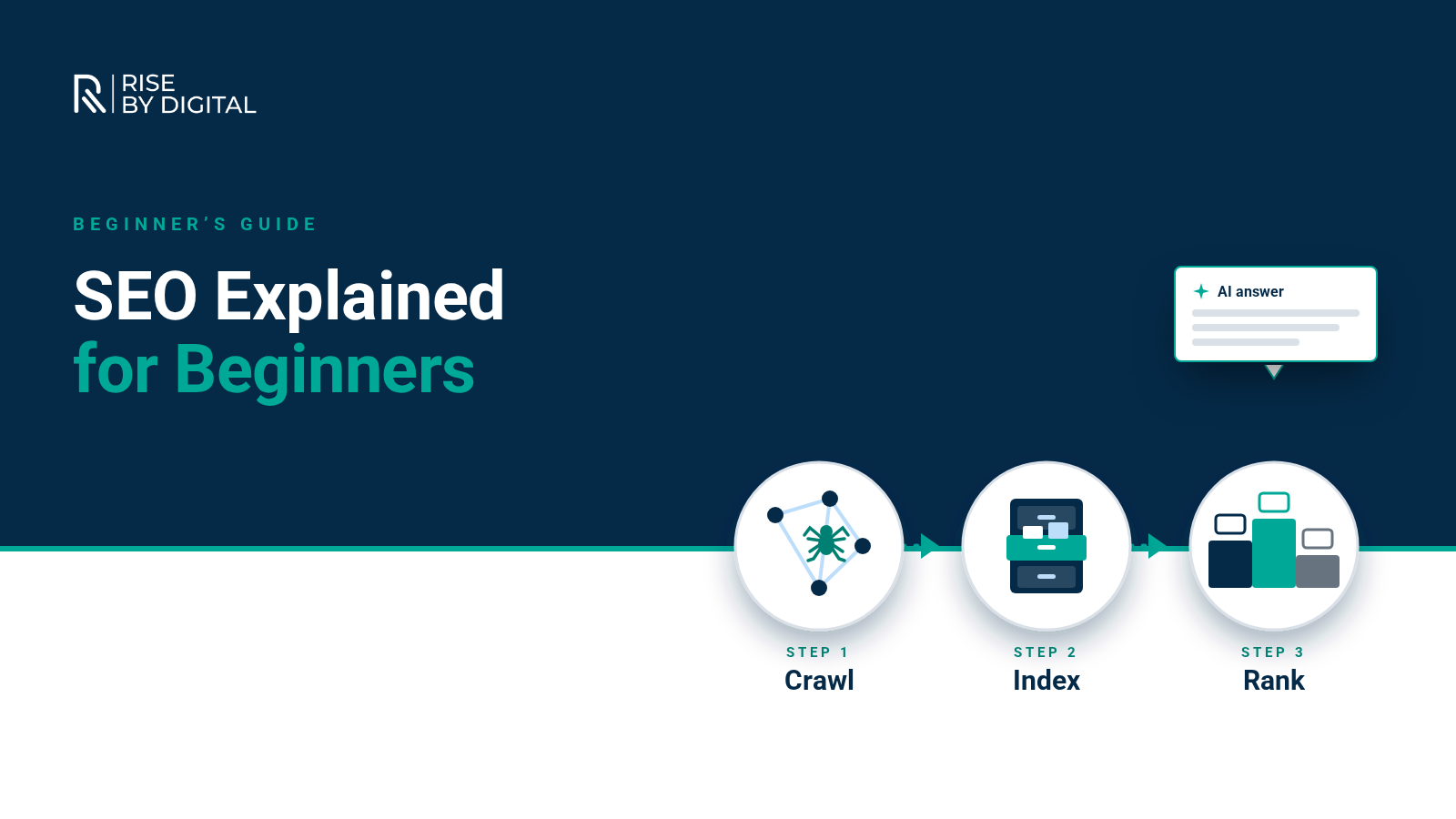
Google's process has three stages, explained in its SEO Starter Guide:
- Crawl: automated programs (Googlebot) find pages on the web.
- Index: Google analyses each page's content and stores it.
- Serve: when someone searches, Google's systems choose the most relevant, helpful results from the index, taking into account things like the searcher's location, language and device.
Google uses many signals to rank pages, and it does not publish a full list. What it does say clearly is that it aims to reward helpful, reliable, people-first content. That is the best single principle to keep in mind.
The building blocks of SEO
Technical SEO
Making sure search engines can crawl and index your site, and that it works well for visitors. This covers site structure, mobile usability, page speed and Core Web Vitals, HTTPS, XML sitemaps, redirects and fixing errors. If Google cannot access a page properly, nothing else matters.
On-page SEO and content
Creating pages that match what people are searching for and answer it well. That includes researching what your customers actually search for, writing clear titles and headings, structuring pages logically, using descriptive image alt text and linking related pages together. Above all, it means content that is genuinely useful: specific, accurate and written from real experience.
Off-page SEO and authority
What the rest of the web says about you. Links from relevant, reputable websites, mentions in the press, and reviews all help show that your business is established and trustworthy. Quality matters far more than quantity, and buying links breaks Google's spam policies.
Local SEO
If you serve customers in a particular area, your Google Business Profile, reviews and local relevance are central. Our guide on how to use local SEO covers it step by step.
What about AI search?
AI Overviews and AI Mode have changed how results look, but not the fundamentals. Google says there are no extra requirements to appear in its AI features beyond normal SEO best practice, and that pages need to be indexed and eligible to show in search (Google: AI features and your website). Clear, well-structured pages that answer questions directly tend to serve both traditional results and AI answers. If you have heard the terms AEO and GEO, our guide to SEO vs AEO vs GEO explains them.
How long does SEO take?
There is no fixed timeline. Google's own guidance is that some changes take effect in a few hours while others can take several months, and that you should usually wait a few weeks before judging whether a change has helped (SEO Starter Guide).
In practice, fixing technical problems can produce gains relatively quickly, while building content and authority in a competitive market takes months of consistent work. Your competitors are working on their SEO too, which is why it is an ongoing process rather than a one-off project.
What an SEO campaign involves
A typical campaign for a small or medium-sized business includes:
- An audit to find technical issues and opportunities (see our SEO audit checklist).
- Keyword and competitor research to understand what your customers search for and who you are up against.
- Technical fixes such as speed improvements, indexing problems and redirects.
- On-page optimisation of your key service and product pages.
- New content that answers your customers' questions.
- Link building and digital PR to earn relevant links and mentions.
- Local optimisation of your Business Profile and reviews, if relevant.
- Reporting on rankings, traffic and, most importantly, enquiries and sales.
Myths to ignore
Google's Starter Guide addresses several common misconceptions directly:
- Meta keywords: Google Search does not use the keywords meta tag.
- Word count: there is no magic minimum or maximum length for ranking.
- Keyword stuffing: repeating keywords excessively is against Google's spam policies and puts readers off.
- E-E-A-T as a ranking factor: experience, expertise, authoritativeness and trust are qualities to aim for, but Google says E-E-A-T itself is not a ranking factor.
And one from Google's guidance on hiring help: nobody can guarantee a number one ranking (Google: Do you need an SEO?).
How SEO helps your business
Organic search reaches people at the moment they are looking for what you offer, and you do not pay per click. Over time, strong rankings can deliver a steady flow of relevant visitors. SEO work also makes your website clearer, faster and easier to use, which improves results from every other channel that sends people there, from Google Ads to social media.
Should you do it yourself or hire help?
Google points out that a small local business can often do much of the basic work itself, and its Starter Guide is a good place to begin. As competition grows, or if you do not have the time, specialist help usually pays for itself. If you hire an agency, ask what they will do, how they will report and what results they expect in what timeframe.
At the time of writing (October 2026), our SEO packages start from £179 a month for local SEO on a 24-month term, with national SEO packages also available.
Quick-start checklist
- Set up Google Search Console and submit your sitemap.
- Check your important pages are indexed.
- Give every page a unique, descriptive title and meta description.
- Make sure your site is fast and easy to use on a phone.
- Write a page for each core product or service that answers customers' real questions.
- Claim and complete your Google Business Profile if you serve a local area.
- Ask happy customers for reviews.
- Earn links from relevant local and industry websites.
Next steps
The best way to understand where you stand is to see your site through a search engine's eyes. We offer a free technical SEO audit with clear, prioritised recommendations, or we can talk through a plan for your business.