
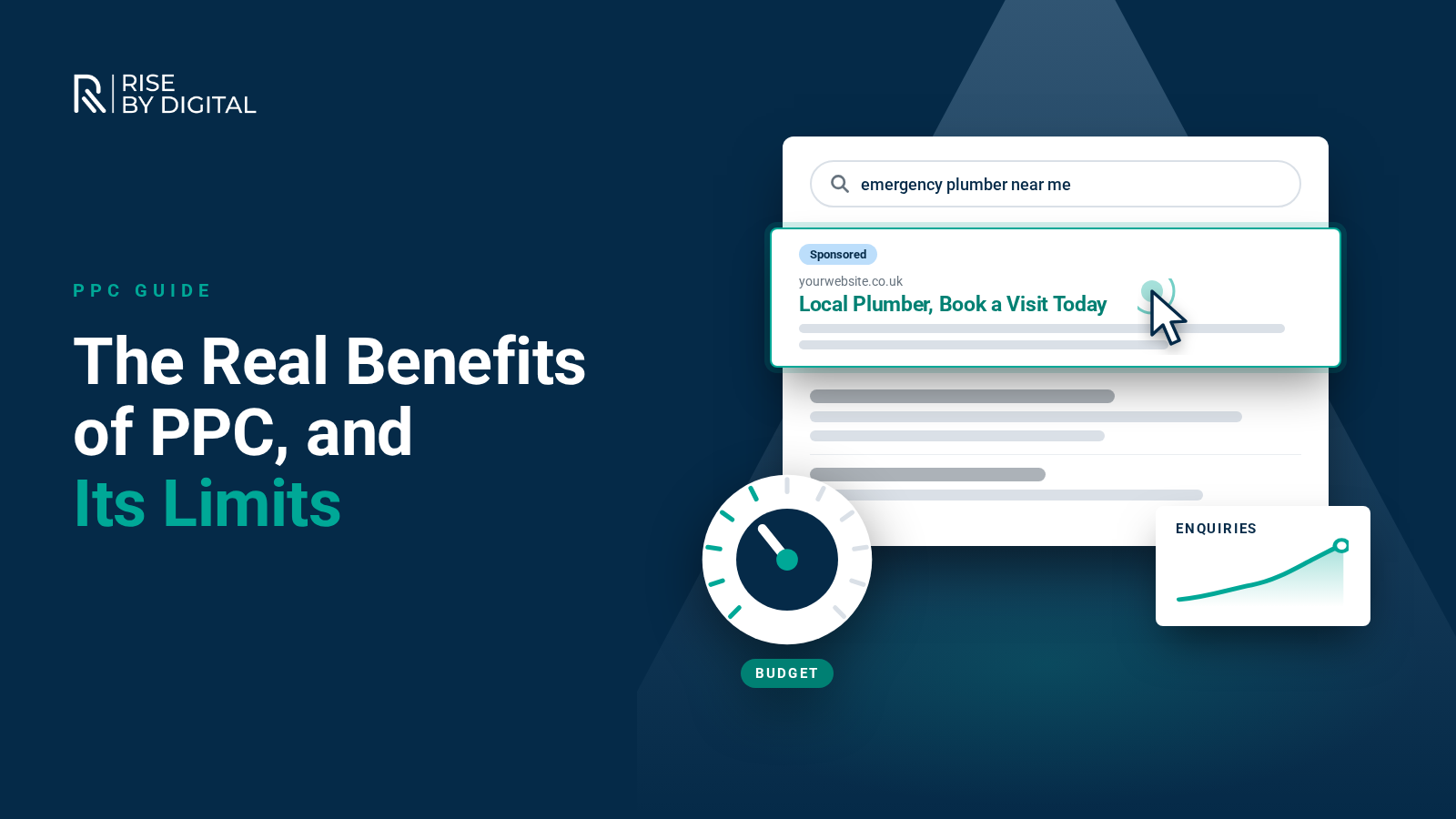
The real benefits of PPC advertising for UK businesses, the limits to plan for, a quick suitability checklist and a simple way to judge whether your ads are paying off.
Pay-per-click (PPC) advertising lets you put an advert in front of people at the moment they are looking for what you sell, and you pay when someone clicks rather than for the space itself. The best-known platform is Google Ads, but the same model runs on Microsoft Advertising, Meta, LinkedIn and others.
PPC is not right for every business, and it is not free money. Used well, though, it is one of the most controllable and measurable ways to win new customers. This guide covers the real benefits, the limits nobody mentions in the sales pitch and how to tell whether it is working for you.
How PPC works, in plain English
You choose the searches (keywords) or audiences you want to reach, write your adverts, set a budget and decide how much you are willing to pay. When someone searches on Google, an auction runs in the background to decide which ads appear and in what order. If a person clicks your ad, they land on a page of your website and you pay for that click.
One point is worth clearing up early, because the old version of this article got it wrong: PPC and SEO are separate. Your ads do not rank because of your SEO, and paying for ads does not improve your organic rankings. Google states that it does not accept payment to rank pages higher in its organic results. The two channels work well together, which we cover below, but they are different systems.
The main benefits of PPC
1. You reach people with clear intent
Search ads appear when someone types a query such as "emergency plumber Leicester" or "accountant for small business". That person has told you exactly what they want. Few other channels let you meet demand at the point it exists, rather than trying to create it.
2. Results start quickly
Once your account is set up, your ads are approved and your tracking works, you can start receiving traffic within days. SEO is valuable, but Google itself says changes can take anything from a few hours to several months to show in search results. PPC fills that gap, which makes it useful for launches, new services and seasonal pushes.
3. You control the budget
You set an average daily budget and can change or pause it at any time. Google explains that on a given day a campaign may spend up to twice the average daily budget, but over a month you will not be charged more than 30.4 times your average daily budget. In practice, that means you can plan monthly spend with confidence and scale up only when the numbers justify it.
4. Targeting is precise
You can decide:
- Which searches trigger your ads, and which do not, using negative keywords
- Where your ads show, from a whole country down to a radius around your premises
- When they show, for example only during office hours if you need to answer the phone
- Which devices and audiences to prioritise
Google's location settings even let you choose between people physically in an area and people who have shown interest in it, which matters if you only serve a local patch.
5. Everything is measurable
With conversion tracking in place, you can see which keywords, ads and landing pages turn clicks into enquiries or sales. The core numbers to watch are:
- Cost per click (CPC): what you pay for each visit
- Click-through rate (CTR): the share of people who see your ad and click it
- Conversion rate: the share of clicks that become leads or sales
- Cost per acquisition (CPA): what each lead or sale costs you
- Return on ad spend (ROAS): revenue earned for every pound spent, for ecommerce
That level of insight is very hard to get from print, radio or most offline advertising.
6. It is a fast way to test messages
Responsive search ads let you supply up to 15 headlines and 4 descriptions, and Google tests the combinations. Within weeks you can learn which offers, prices or benefits people respond to. Those lessons are useful well beyond your ads, from your homepage copy to your email subject lines.
7. It supports your SEO rather than replacing it
The search terms report shows the real phrases people use before they buy. That is excellent research for your organic content. PPC can also keep you visible for important terms while your SEO builds, and give you a second listing on the page when you already rank well.
The limits you should know about
A fair view of PPC includes its downsides:
- Traffic stops when spending stops. Unlike a well-ranked page, ads deliver nothing once the budget ends.
- Some sectors are expensive. In competitive markets such as legal or finance, click prices can be high, so small budgets do not go far.
- Clicks are not customers. A slow or confusing landing page wastes money. Your website has to convert, which is why we often pair PPC with a UX and conversion review.
- Poor set-up burns budget. Loose keyword settings without negative keywords can show your ads for irrelevant searches.
- It needs ongoing attention. Accounts that are left alone tend to drift as competitors, costs and Google's own features change.
None of these is a reason to avoid PPC, but each is a reason to plan it properly.
Is PPC right for your business? A quick checklist
PPC tends to work well when most of these are true:
- People actively search for your product or service
- You know roughly what a new customer is worth to you
- Your website has a clear, fast landing page for each main service
- You can respond quickly to enquiries, especially calls
- You can commit a test budget for at least two to three months
- You are able to track enquiries, calls or sales as conversions
If several are missing, fix those first. Advertising will magnify whatever is already there, good or bad.
A simple way to judge whether it is working
Here is an illustrative example, not a forecast. Say you spend £1,000 in a month at an average of £2 per click. That buys around 500 visits. If 5% of those visitors enquire, you have 25 leads at a cost of £40 each. If one in five leads becomes a customer worth £600, those five sales bring in £3,000 from £1,000 of ad spend, before management fees and other costs.
Your own numbers will differ, so the point is the method: work out what you can afford to pay for a lead or sale, then judge the campaign against that figure rather than against clicks or impressions.
What does PPC cost?
There are two parts: the ad spend you pay to the platform, and the cost of managing it, whether that is your own time or an agency fee. Our guide to how much PPC management costs explains the common pricing models in detail.
At Rise By Digital, our published Google Ads management packages start with Launch at £285 a month plus 9.5% of ad spend for budgets under £2,500 a month, at the time of writing. If you already run ads and want an outside view, our free PPC audit checks your account for wasted spend and missed opportunities.
Making PPC pay
The benefits of PPC are real: intent-led reach, speed, control and data. They show up when the basics are right. That means relevant keywords, tight targeting, ads that match the search, landing pages that convert and tracking you can trust. Get those in place and PPC becomes a dependable source of leads you can scale up or down as your business needs.
Our 10 simple ways to decrease your CPA is a good next read once your campaigns are live.