
Most marketing dashboards show you what happened. Hookology - built by Rise By Digital - connects your data, business context and activity so you can see what is happening, why it matters, and what to do next.
Meta tells you one story. Google Ads tells you another. GA4, Search Console and your ecommerce platform each keep their own version of events. By the time those fragments have been turned into a deck, the moment to act may already have passed.
This is the quiet failure mode of modern marketing operations. Every channel can look healthy in isolation while the commercial picture drifts: CAC rises because creative is ageing on one network, ROAS holds only because budget has concentrated on a shrinking set of winners, and organic demand softens weeks before paid performance shows the same pressure.
Marketing teams do not have a shortage of data. They have a shortage of clear, timely decisions. That is why Rise By Digital built Hookology: marketing intelligence that connects the numbers to the realities of the business, then helps you see what is happening, why it matters, and what to do next.
Why fragmented data fails
Conventional dashboards inherit the fragmentation of the platforms beneath them. They can place channel reports next to one another, but adjacency is not the same as intelligence. A board slide with Meta, Google and Shopify side by side still leaves someone to reconcile definitions, windows, attribution models and commercial meaning by hand.
That handwork is where decisions stall. On a typical Tuesday morning, a growth lead may be trying to answer four questions at once: Is this week’s CPA rise a creative problem or a traffic-mix problem? Should the next budget move go into prospecting or into the campaigns that still clear margin? Is Search soft because demand is soft, or because the site is leaking? And which of those answers can wait until Friday?
Fragmented tooling pushes each of those questions into a different tab. The result is not merely inconvenience. It is delayed action, duplicated effort, and recommendations that never quite survive contact with margin, stock or capacity.
Dashboards also miss the context that changes a decision: commercial goals, margins, seasonality, stock, cash and the way the brand needs to grow. Without that context, a movement in clicks or revenue is only part of the story. And most reporting still looks backwards. It explains what has already happened when the useful question is: what should we change before Friday?
What “marketing intelligence that thinks like your team” means
Hookology is the intelligence engine for growth teams. It connects marketing data, business context and day-to-day activity, then helps explain what is happening, why it matters and what to do next. The point is not another wall of charts. The point is a shared operating view that behaves more like a careful colleague than a reporting export.
In practice, that means the platform is designed to detect meaningful movement, diagnose likely causes, understand your commercial constraints, and recommend a next move with the evidence attached. When CAC rises, the useful answer is not a red arrow. It is which network, campaign or creative is driving the change, how confident the signal is, and what a proportionate response looks like against your own ROAS or margin rules.
That is what “thinks like your team” means. It does not invent a strategy for you. It reduces the distance between a live account and a defensible decision, using the same commercial language your team already uses: targets, thresholds, seasonality, brand rules and the work that still needs human judgement.
Five connected pillars, one intelligence layer
Hookology is organised around five connected pillars rather than a shelf of disconnected tools:
- Performance intelligence - decisions, budgets, forecasts and the daily brief that turns noise into ranked actions.
- Creative - scoring, briefs, fatigue and testing so creative work is judged against what actually converts.
- Search and site - organic demand, technical health and website performance as part of the same growth picture.
- Growth and market - opportunity, competitors, audience and forecasting that shape where budget should go next.
- Operations - governance, protection, goals and delivery so the system stays trustworthy as the account evolves.
All five feed the same intelligence layer. A creative fatigue warning is more useful when it can be read against live media performance. A budget recommendation is safer when it respects margin and pacing. An SEO issue matters more when it sits beside paid demand rather than in a separate monthly report. You can explore the platform for the wider feature map; the editorial point is simpler: connected pillars change the quality of the decision, not just the quantity of screens.
What changes day to day
The CEO Dashboard gives leaders an executive view of the signals that matter, including the Opportunity Score, its contributors and a strategic briefing drawn from their own numbers. The detail remains available, but the starting point is a decision rather than a wall of metrics. That shift matters because most experienced marketing time is spent reconstructing context that should already be shared.
Decision Centre
The Decision Centre turns recommendations, risks, competitor moves and alerts into a prioritised daily brief. Each signal keeps its evidence attached, with confidence labelled so thin findings are not presented with the same weight as proven ones. Teams can approve, snooze or dismiss items, and the queue becomes a working list rather than another inbox of generic warnings.
Day to day, that changes the morning ritual. Instead of opening six platforms and rebuilding yesterday by hand, the team starts from a ranked set of actions: what moved, why it appears material, and what the next proportionate step is. The Decision Centre does not remove ownership. It removes the scavenger hunt that usually comes before ownership can begin.
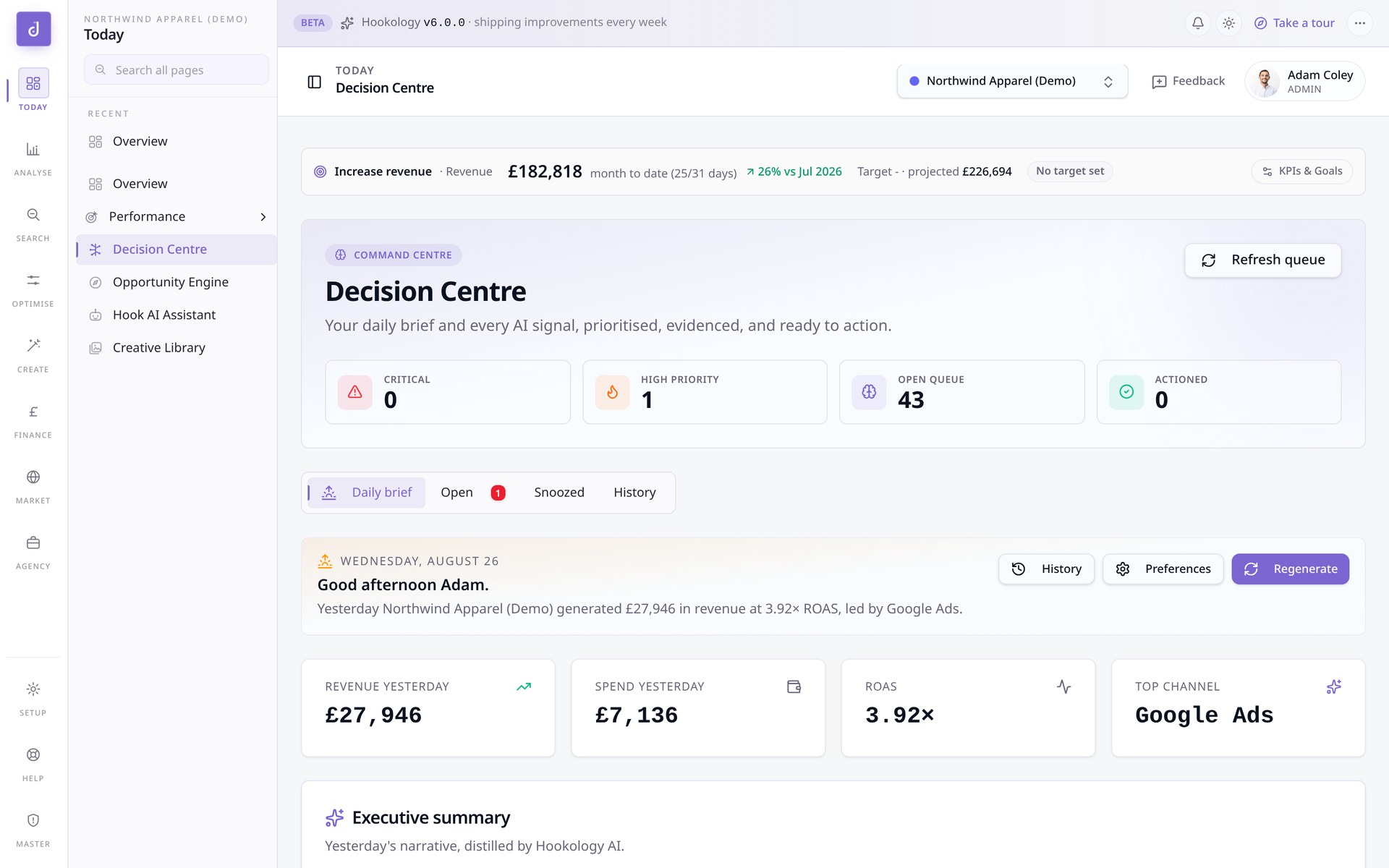
Decision Centre - prioritised signals with evidence attached.
Performance and budgets
Performance and Budgets brings spend, revenue, ROAS, conversions, CPA, CTR and CPC across networks into one view, each compared with the previous period and with forecast. Top performers and liabilities are flagged, with campaign, objective and network breakdowns available when the conversation needs more depth.
This is where budget arguments usually improve. Rather than reconciling disconnected exports before anyone can discuss a move, the team can examine a proposed shift with the maths already visible: pacing against the month, elasticity where it has been learned, and the commercial impact of the change. It helps teams catch monthly pacing problems while there is still time to adjust, and it gives finance a clearer trail when marketing spend needs defending.
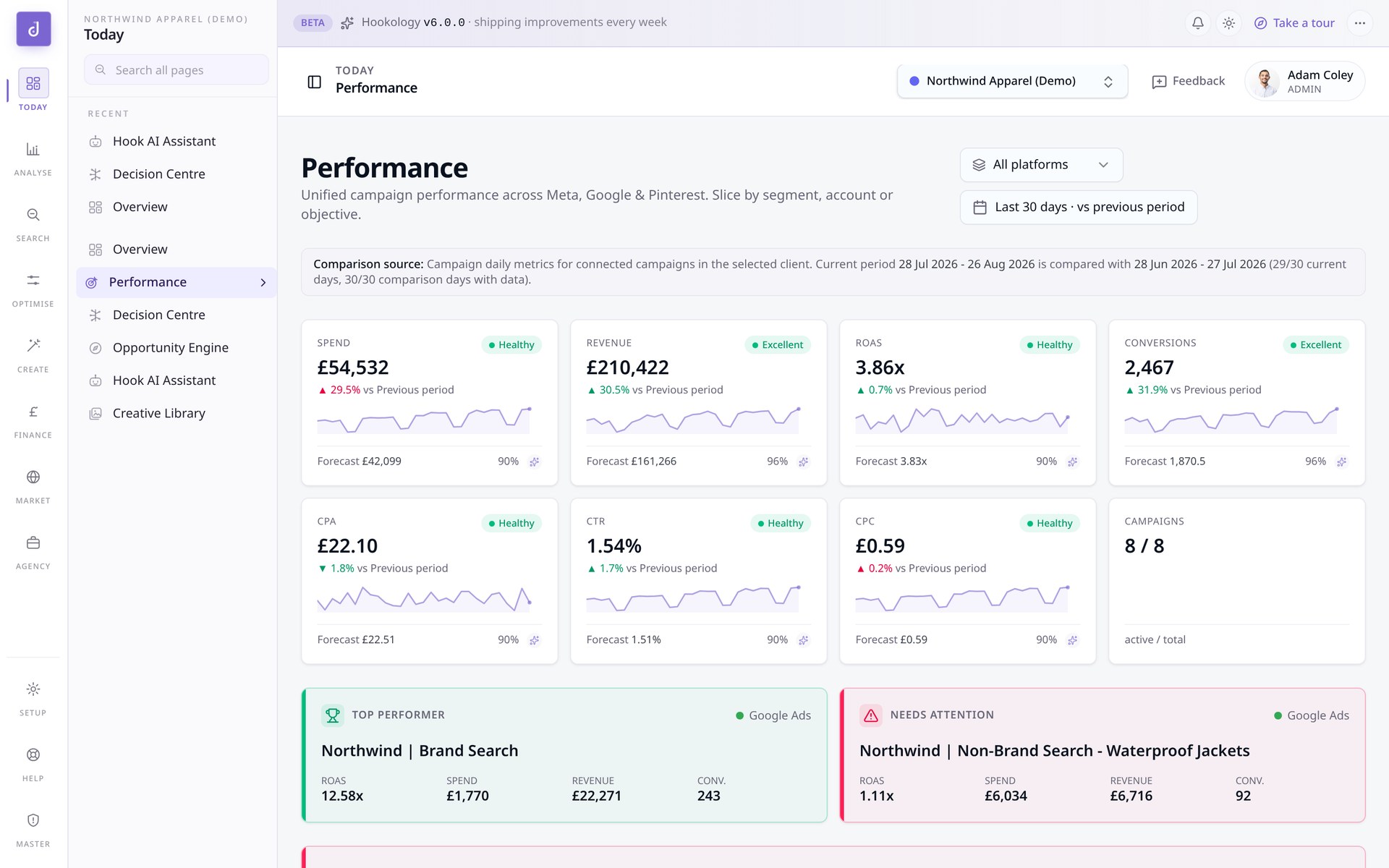
Performance and Budgets - KPIs and network view in one place.
Where AI helps - and where it does not
AI is useful when it shortens the path from signal to decision. In Hookology that includes daily briefing in plain English, prioritised recommendations with evidence tiers, creative tagging and scoring, fatigue warnings, and assistive exploration through Hook AI. The Context Engine holds commercial truth - goals, margins, thresholds, seasonality and strategic priorities - so recommendations are scored against what the business is actually trying to achieve rather than a generic template.
AI is less useful when it pretends to replace judgement. Hookology is deliberately not a self-serve wizard that invents your operating model. Workspaces are scoped and built around your channels, margins and rules, then run with a named account manager. The system can surface elasticity, confidence and options; people still decide whether a budget move fits stock, brand risk, capacity or a wider commercial plan. That boundary is intentional. Marketing intelligence should accelerate good decisions, not obscure who owns them.
Why Rise By Digital built Hookology
Hookology was built by Rise By Digital from the practical work of running SEO, paid media, social, web and marketing strategy. We kept meeting the same gap: every agency can send a report, but far fewer tools help a team decide what to do this week with the money attached to the recommendation.
That experience shaped a platform designed around connected decisions rather than isolated channel reports. Creative intelligence, forecasting, Revenue Guard and the wider operations layer support the same goal without turning the product into a feature catalogue for its own sake. The delivery model follows the same logic: discovery, a bespoke build and 1-2-1 account management, because growth intelligence only works when it understands the business it is advising.
For a look at how that thinking is holding up in practice, Adam has written about what we have been changing in Hookology over the last few weeks.
See what Hookology finds
When marketing information is connected to business context, the next move becomes easier to see. If your team is spending more time assembling the picture than acting on it, Hookology is built for that problem: one intelligence layer across paid, organic and website data, with decisions ranked, evidenced and ready for human judgement.
Prefer to speak with Rise By Digital? Talk to our team.